Showing posts with label Manobo art. Show all posts

Friday, April 1, 2016

Bamboo Cases for Betel Quid

Let me admit it at the outset: I don’t know the correct Manobo name for the object that I’m going to feature today. This is quite a failure on my part as a researcher, considering my claim that the object is my favorite among the displayed items in Delesan Menubo. The object is a tiny bamboo stem used by Manobo men as a container for their betel quid. Each one has an accompanying lid, apparently fashioned from the same stem. If it were made of plastic, it can be easily mistaken for a lipstick case, albeit fatter.

What I like about the tiny bamboo case is the design on its surface. The design is carved on the bamboo with probably the tip of a penknife, and each case has a unique design. If you look closely, you can see that the design is composed only of simple geometric cuts, but when viewed as a whole, the cuts make the bamboo case a work of art. The design looks so intricate that I want to have a collection of these betel quid containers. One of the cases displayed in Delesan Menubo even has braided strips of black vine wrapped around it as an additional decoration.

I thought the name of the object is fuyot, which is described in the Kitab (Dulangan Manobo Customary Law) as “gamit ng lalaki lalagyan ng mama” (men’s container for betel quid). My other sources state, however, that a fuyot is a small drawstring bag. Maybe anything that is used to keep betel quid is called fuyot. When I asked the Manobo girls in Delesan Menubo what a fuyot was, I think some of them pointed a cloth bag and some of them pointed the tiny bamboo cases. I have to look for a Dulangan Manobo again to verify these things. For now, let me show you the three bamboo cases on display in Delesan Menubo.


Update: I've learned that the tiny case is called a selapa. I wrote the post in November 2015, and I asked a Manobo woman for the correct term in January 2016.

(Blogger's note: This post is part of a series on items that the Dulangan Manobo people traditionally use in their daily lives. Special thanks to the RNDM nuns assigned in Kulaman Plateau. For more information about the series, read my introductory post or click the label Delesan Menubo below.)

Friday, March 25, 2016

Manobo Bags

My hometown named its annual festival after the solok, but the Manobo basket I like most is the kelepi, shown in this photo. To know the different types of Manobo baskets, check out my post the previous Friday.

I failed to properly identify this bag displayed in Delesan Menubo. Among my list of Manobo baskets, the description of a kampilu is the closest to this bag: “oval, vine, tightly woven, large.” This bag, though, is made of reed instead of vine. Based on the description, a kampilu should look like a huge kelepi, but I didn’t see any such basket in the display room. Thus, for now, I’m calling this object a kampilu.

(Blogger's note: This post is part of a series on items that the Dulangan Manobo people traditionally use in their daily lives. Special thanks to the RNDM nuns assigned in Kulaman Plateau. For more information about the series, read my introductory post or click the label Delesan Menubo below.)

Friday, March 18, 2016

Manobo Baskets

Get to know your Manobo baskets. Here’s a basic guide, based on the Cotabato Manobo Classified Vocabulary by the Summer Institute of Linguistics and on my own research:

baskit—round, rattan, open weave, with handle, small to medium
alat or melit—round, rattan, open weave, no handle, large
solok—round, bamboo, tightly woven, without lid, small to medium
sinagpeng—round, bamboo, tightly woven, with lid, small to medium
suladan—round, bamboo, tightly woven, large
kelepi—oval, vine, tightly woven, small
kampilu—oval, vine, tightly woven, large

Sinagpengs have lids and soloks don’t. Take note
of that very simple difference.

My bro demonstrates how the Dulangan Manobos
carry their baskets. Now you know why
the slings are unusually long.

(Blogger's note: This post is part of a series on items that the Dulangan Manobo people traditionally use in their daily lives. Special thanks to the RNDM nuns assigned in Kulaman Plateau. For more information about the series, read my introductory post or click the label Delesan Menubo below.)

Friday, March 11, 2016

Manobo Pouches

Traditional Manobo men own a cloth bag called puyot, into which they put their betel quid and other important things. According to Defending the Land, a book on ancestral domain claims in Mindanao, a puyot is “usually colored blue” and “slung around [the] forehead even in plowing the field, to reach out to while resting from the task.

The other puyot displayed in Delesan Menubo is plaid and looks more “tribal.” Its string is also made of abaca, a native fiber. The string of the blue puyot, shown in the first photo above, is made of a synthetic material.

Just like how they wear their tubaw, Manobo men wear their puyot as they please. This grandfather prefers to sling the string on his shoulder and keep the cloth bag on his chest.

(Blogger's note: This post is part of a series on items that the Dulangan Manobo people traditionally use in their daily lives. Special thanks to the RNDM nuns assigned in Kulaman Plateau. For more information about the series, read my introductory post or click the label Delesan Menubo below.)

Friday, March 4, 2016

How to Wear a Tubaw

Among the Dulangan Manobo people, the datu (chieftain) wears a tubaw (headscarf) almost all the time. The scarf is a symbol of their high standing in the community. But as far as I know, ordinary men may also wear a tubaw. It’s not prohibited. (As to women, they don’t wear a tubaw; they wear headdresses instead.) I like tubaws. I like wearing them, especially on important occasions. I don’t know why. Perhaps it’s because wearing a tubaw is an easy way to draw attention to myself. Non-indigenous men rarely wear a tubaw, if at all, and I like being different—I sometimes like showing people that I’m different. Perhaps it’s also because I simply can’t resist the exquisiteness of tubaws. They have simple yet regal designs. Indeed, the question should not be “Why do I wear a tubaw?” It should be “Why are we not wearing it?” We wear Western clothing most of the time, and we don something K-Pop or anime if we feel like experimenting. So why not tribal? Why not a tubaw? It’s our own. You can even express your creativity with a tubaw. There’s no prescribed way of wrapping the cloth around your head and tying its ends. Just look at the men below. The styles of their tubaws reveal different personalities. I can create a life story for each of them based on the headscarves alone.


(Blogger's note: This post is part of a series on items that the Dulangan Manobo people traditionally use in their daily lives. Special thanks to the RNDM nuns assigned in Kulaman Plateau. For more information about the series, read my introductory post or click the label Delesan Menubo below.)

Friday, February 26, 2016

Manobo Bracelets and Anklets

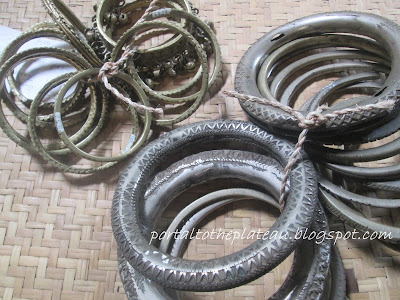
You can tell a sugot (bracelet) from a sigkil (anklet) from their sizes.
The latter is normally bigger.

Sigkils go well with apol (tattoo).

Sugots may be made of nito, a native vine.

(Blogger's note: This post is part of a series on items that the Dulangan Manobo people traditionally use in their daily lives. Special thanks to the RNDM nuns assigned in Kulaman Plateau. For more information about the series, read my introductory post or click the label Delesan Menubo below.)

Friday, February 19, 2016

Manobo Belts

Binulan-bulan, a decorative belt for men

This belt, worn by Manobo women on special occasions, is part-ornament part-musical instrument. Each of the tiny brass balls is hollow and contains a tinier ball inside. The bells chime when the wearer of the belt walks and dances.

Brass is expensive for the Manobos, so many of the women make do with belts that are made of beads and have a few brass bells only. The beaded belts, nonetheless, are beautiful on their own.

(Blogger's note: This post is part of a series on items that the Dulangan Manobo people traditionally use in their daily lives. Special thanks to the RNDM nuns assigned in Kulaman Plateau. For more information about the series, read my introductory post or click the label Delesan Menubo below.)

Friday, February 12, 2016

Manobo Necklaces

The basak (necklace) of Manobos is made normally of beads and tiny brass bells and sometimes of animal teeth. 

Another sample of a basak worn by Manobo women. Men rarely wear necklaces, and when they do, theirs are usually much simpler.

Not all basaks are large and flashy. I bought these simple ones for some friends.

(Blogger's note: This post is part of a series on items that the Dulangan Manobo people traditionally use in their daily lives. Special thanks to the RNDM nuns assigned in Kulaman Plateau. For more information about the series, read my introductory post or click the label Delesan Menubo below.)

Friday, February 5, 2016

Manobo Earrings

Tunggal (large hoop earring) is one of the distinctive ornaments of Manobo women. The earring is worn in a series, the smallest hanging from the top of the ear and the biggest hanging from the earlobe. Manobo men used to wear tunggals too, but they stopped due to the influence of Christian migrants from Luzon and Visayas.

Suffering for the sake of beauty. Tunggals have caused the ears of this Manobo woman to swell and be deformed.


Simple mechanism. The brass loop is inserted through the hole in the ear. The two ends of the loop are then joined inside a bead.

(Blogger's note: This post is part of a series on items that the Dulangan Manobo people traditionally use in their daily lives. Special thanks to the RNDM nuns assigned in Kulaman Plateau. For more information about the series, read my introductory post or click the label Delesan Menubo below.)

Friday, January 29, 2016

Manobo Head Ornaments

In Dulangan Manobo, the general term for a headdress is kemage.
If it is attached to a comb, it is called a sudong.

A sudong

A kemage

A pakul (hair tie)

(Blogger's note: This post is part of a series on items that the Dulangan Manobo people traditionally use in their daily lives. Special thanks to the RNDM nuns assigned in Kulaman Plateau. For more information about the series, read my introductory post or click the label Delesan Menubo below.)

Friday, January 22, 2016

Manobo Accessories

The following are the names of personal adornments that the Dulangan Manobo people traditionally use: tubaw (head scarf, for male chieftains usually), tedong (cloth head covering), sayap (hat), sapeyo (cap), kemage (headdress), sudong (headdress with comb), pakul (hair tie), tunggal (earring), basak (necklace), sugot (bracelet), tising (ring), sabitan (belt), sigkil (brass anklet), and tekes (beaded anklet for men). In the coming Fridays, some of these items will be individually featured on this blog.

I want to have whatever it is that is hanging from the head of the guy
in this photo. 

I like the supermodel mien of this Manobo girl.
She’s playing a togo, a bamboo harp.

(Blogger's note: This post is part of a series on items that the Dulangan Manobo people traditionally use in their daily lives. Special thanks to the RNDM nuns assigned in Kulaman Plateau. For more information about the series, read my introductory post or click the label Delesan Menubo below.)

Friday, November 27, 2015

My Own Kelepi

The bag is made of three different native materials. 

As told in previous posts, I was informed while I was in Kulaman village that I was one of the five finalists in the inaugural F. Sionil Jose Young Writers Awards. I wanted a few things tribal to wear with my black long-sleeved shirt, skinny brown pants, and brown leather shoes, so I bought a tubaw (head scarf) and a kelepi (small sling bag made of native materials). The tubaw is simply a square plaid cloth that is mostly red. It’s a common item among the indigenous and the Islamized people of Mindanao. The kelepi is more interesting, and it will be the focus of this post.

I asked my mother to identify the materials that the bag is made of. She said that the main material is pawa, a kind of native bamboo, which is much smaller than regular bamboo. The black strips interweaved with the brown bamboo strips are nito, a vine that grows in forests. No paint, varnish, or any artificial coloring was used in my kelepi. The sling is made of abaca, a tree that looks like a banana and whose bark yields a very strong kind of fiber. The fiber used for the sling is braided. Pawa, nito, and abaca are Hiligaynon terms because it is the first language of my family. Unfortunately, I don’t know yet the counterparts of those terms in the Dulangan Manobo language.

I loved the kelepi since the first time I saw a sample of it. Weaving one obviously takes time and requires skill. When I learned from my mother how the craftsman has to make use of three different raw materials, I appreciated the output even more. The kelepi is now one of my most-prized possessions. I consider it more precious than the black leather wallet and the modern gadgets that I keep inside it.

Definitely a work of art, the bag itself is as valuable
as the things that Manobos put inside it. 

Even the minimalist back part looks exquisite. 

The cover is snug-fit even without a zipper or a strap. 

Monday, January 6, 2014

Art and Culture of the Dulangan Manobo

(Blogger’s note: The following is an excerpt from Defending the Land: Lumad and Moro People’s Struggle for Ancestral Domain in Mindanao, specifically pp. 109–10. The publishers welcome and even encourage the reproduction of the book in part or in its entirety, so I am posting this excerpt here without prior permission. Not a single word has been changed, and the style of the text as they appear on the book has been preserved. For complete citation, please see Webliography.)

The Manobos of Kulaman do not normally wear their tribal costumes and adornments in their daily undertakings. They only wear these during special occasions and gatherings.

In their traditional wear, the Dulangan Manobas of Kulaman don a saya, often a patadyong, and a long sleeved figure hugging V-necklined blouse called kawal. They only wear an occasional bracelet, ligti, which they secure from the nearby T’boli villages. They adorn their necks with beads, in single or several layers, that they learn to make themselves. Some Manobo women are able to purchase more intricate necklaces from department stores in nearby semi-urban centers.

Betel chewing Manobas sling on their shoulders a small rectangular shaped cloth bag called solok, measuring 4 inches by 6 inches, containing the ingredients for chewing. They may also wear sigkil (anklets) on their legs. The males have similar cloth bags called fuyot, usually colored blue, and larger than the women’s solok. They sling this around their forehead even in plowing the field, to reach out to while resting from the task.

The datu has several rows of earrings called tunggal, some reaching the upper section of the earlobes. Many of the present day datus have stopped wearing this, probably influenced by the Christians who see this as an unusual sight.

The older datus wear their hair long and tie it into a bun, while younger generations of datus have shorter hair. The datus also wear a long sleeved shirt called kawal; the short sleeved shirt they call fotok.

One distinctive feature of the adult Manobo is the ever present tattoo on parts of their bodies, the most noticeable being those on the wrists or on the legs. There may also be tattoos on their waists or around their nipples, on both men and women.

The tattoo may be any design in accordance with the tattoo artist’s conception, ranging from connecting squares or rectangles to more elaborate ones. It is said to serve as an indication of their noble aspirations of keeping to the right path in their journey through life, a path that will lead them to a place called Baya, equivalent to the Christian’s heaven.

During the Spanish times, tattoos were done purely for ornamentation purposes, but later, this was utilized as form of identification to protect victims of kidnapping for slavery. When a victim was captured, it was customary to change the name as often as the victim was sold or resold. The only manner to identify said captive was by his tattoo marks on some parts of his body.

The Manobos of Kulaman have similar tattoo marks, no longer as indications of slavery, but now with purely spiritual intentions, as some kind of guidance to the other world, the baya. Children do not have tattoos on any part of their bodies.