Monday, August 4, 2014

Treasure Hunting Activities

When I was still in college, I wrote about treasure hunting practices and beliefs, and the piece appeared in the Young Blood column of the Philippine Daily Inquirer. More than eight years since, I found out that some people here in Kulaman Plateau are still as crazy about finding the purportedly lost treasures of General Yamashita. One expedition even has a backhoe at its disposal. Big time! The group must have a wealthy financer.

Let me be blunt about it: I consider such an undertaking foolish, something reasonable people should not do if they care about the future of their family. It’s a big waste of time, money, and even dignity. There is no clear evidence that the Japanese set foot in these boondocks during World War II. Since pre-Spanish time, there was no one here but the indigenous Dulangan Manobo. Outsiders, mostly Ilonggos and Ilocanos, only started to flock here in 1960s and 1970s.

 Treasure hunters use a backhoe to dig a hole. Most diggers in Kulaman
Plateau use shovels, so this particular group probably has a wealthy 
financer. The hole is covered with tarpaulin to hold off gossipmongers.
I’m sorry for the blurry and badly angled photo; I have to take this
covertly because a man in civilian clothes seemed
to be guarding the hole when I passed by.

One illogical thing most of these hunters believe is that the treasure moves. They say that one taboo committed by anyone around could be enough for the chest of gold bars to change location. So the diggers speak in hushed codes, don’t let strangers take a peek at the hole, and walk on tiptoe. OK, I just made up the last one. My point is that excavation is almost like a holy ritual for these people—no dirty jokes and rum drinking at the site. If they know I’m writing this and making light of their life-changing endeavor, they would accuse me of putting a jinx on them. Heck, some of these people might even be homicidal because they’re putting all their resources on the excavation, so I’m not going to specify the locations of existing treasure hunting activities.

Perhaps the only good thing these treasure hunters contribute is that they sometimes stumble on an entirely different kind of treasure. The narrow entrance to the magnificent White Cave of Kuden was first suspected to be a tunnel dug by fleeing Japanese soldiers. A treasure hunter shoveled the dirt and found an immense underground hall of sparkling speleothems. (I wrote a fictional account of discovery in another post.) The clay burial jars of Maitum, Sarangani Province, were also discovered by men searching for treasures in a cave.

My brother and his classmate pose near abandoned holes
by treasure hunters at the top of Ilyan Hill, considered mystical
by the Dulangan Manobo. Many hunters believe that yellow
Chinese bamboos indicate a treasure’s location.

In the same manner, hunters can also destroy valuable archaeological artifacts. In a cave in the village of Tacupis, it is said that there was once a bas-relief of a woman on its wall, and treasure hunters broke the figure to see if the woman had golden internal organs. Kulaman Plateau, having a Karstic topography, is a land of a hundred caves, and who knows what the treasure hunters have been digging or smashing inside them for the past few decades.

And writing this has made me thinking: Perhaps there should be a municipal ordinance banning any form of excavation or at least requiring excavations to seek a permit first. This way, treasure hunters could dig in their backyard or even inside their house to their hearts’ content but caves and other natural treasures—Kulaman’s true treasures—could be protected.

Monday, July 28, 2014

Fiction: Artifacts He Unearthed

During the Silliman University National Writers Workshop last May, my co-fellows and I were asked to create a batch anthology. Our indie book is worth mentioning in this blog because my story in it has got a lot to do with this blog. Here are five fun-for-me facts about the piece:
  1. The story is in the form of blog posts.
  2. The story is about blog posts that quote blog posts that quote blog posts.
  3. I am the main blogger in the story, and I am writing about the blog of my co-fellow Jovy, who wrote about his experiences in Kulaman Plateau and my blog about Kulaman Plateau.
  4. I am writing my blog posts in 2017, and Jovy (whom I killed with his permission) wrote his in 2015, and he made references to this very blog that you are reading, written from 2012 up to the present.
  5. I call my piece "speculative metanonfiction," but my co-fellow and roommate Reno said it's really a fan fiction of myself.
You may read my story by downloading for free the anthology in the webpage of the writers workshop. Scroll down to the image of the book cover, and click the link right below it.

I won't tell you to enjoy reading my story because I wasn't thinking at all of readers when I wrote it. I was just excited by the fact that, for the first time in a little more than a year, I was writing a new story. I hope to take the part about Jovy in the story and rewrite it in a traditional narrative format in the coming months.

"Arguably the best-produced anthology" was how Sir Ian, coordinator
of Silliman's creative writing center, described our book.
The cover photo, taken by Arkay, shows Pre jumping off a cliff
in Siquijor. Jonggai did the book layout, and Reno wrote the intro.

My goal was to have the longest output among those who wrote
their pieces while in the Writers Village, so my story occupies 20
of the 124 pages of the book. I mentioned my name at least 10 times,
so maybe Reno was right: the story is a fan fiction of myself.

My excuse for including this photo is that I need to show you what
the whole book looks like. This was taken by Mike, alumnus
of the same workshop.

Monday, July 21, 2014

Anthropomorphic Lids


While conducting my personal—and mostly online—research on the Kulaman Plateau limestone burial jars, my vocabulary also expanded. One of the first new words that I learned and that I now regularly use is the adjective anthropomorphic, defined by Merriam-Webster as "described or thought of as having a human form or human attributes." The term is usually used to describe the lids of many of the burial jars, and here now are photos of jar coverings that are anthropomorphic.

The photos in this post were all taken at the University of San Carlos Museum in Cebu City. Most of the figures are crudely carved, and some look more like monkeys than human beings. However, probably out of respect by the authors, none of the academic papers I've read so far states that the lids are simian. Curiously, though, a paper or two describe the lids as "phallic," though I can't identify right now which papers do.

Look closely at the photos at the bottom of this post. The one on the right-hand side is a close-up of the lid of the jar at the left. When I first saw the jar in the museum, I thought to myself that the lid was indeed phallic. But when I looked at it closely, I noticed that tiny holes were bored into it, and the holes resembled a human being's eyes, nostrils, and mouth. I wondered if the lid was just unintentionally phallic.

I also remember now that I read in one academic paper that some of the Kulaman jars have designs that indicate the sex of the deceased interred inside. I'll get back to you on this in future posts. It's interesting to think that the ancient people of Kulaman Plateau had manifestations of their sexuality in their art. They were, after all, human beings like us—living, loving, longing.


Thursday, July 10, 2014

The 100th Post: Portraits at the Plateau

At the provincial museum, June 2014

After being gone for a year, I'm back here in Sultan Kudarat Province. This also happens to be my 100th post for this blog. So to mark these occasions, I'm giving you . . . photos of me!

Ha-ha. I'm just being vain, of course. I'm using these lame reasons to turn this blog into a Facebook or Instagram account. Cut me some slack, though. I let 99 posts pass before doing this. If you have noticed, aside from the About Me page, I don't have a photo of me anywhere in this blog. I did it on purpose. I wanted to post here as few personal stuff as possible. Also, whenever I wrote about something, I would choose only the most relevant or best-looking photos to accompany the text, and normally there would only be three to five photos. My selfies never made the cut.

Next to vanity, my purpose in posting my photos is to show you proofs that I have really been to the spots that I have featured in this blog. So one photo below is of me in the White Cave, in Sitio Siokong, Barangay Kuden, Senator Ninoy Aquino. Another one shows me at the top of Ilyan Hill. The photo has an accompanying one-minute video in another post, and I've written about the hill when I had not yet climbed it.

Inside the White Cave, March 2013

At the peak of Ilyan Hill, March 2013

Thursday, July 3, 2014

A Glimpse of White Cave

No, this is not a gooey baby alien. This very hard rock
is a chunk of a speleothem from the White Cave of Kulaman. 

I visited the provincial museum last week to see the limestone burial jar that I had heard was on display there. To my surprise, the jar was not the only item in the museum that came from Kulaman Plateau. The bare collection also included a chunk of speleothem from the White Cave in Sitio Siokong, Barangay Kuden.

When the staff pointed the smooth white rock to me and said it was from a cave in the municipality of Senator Ninoy Aquino, I was appalled. Tourists aren't supposed to touch the stone formations in the cave, much less take a chunk and bring it home. But since the deed has been done, I guess there's no point going ballistic over it. I just hope that (1) the rock was taken out of the cave for the sole purpose of displaying it in the museum, (2) no other rock has been taken out of the cave, (3) a similar thing will not happen in the future.

I noticed that the piece of speleothem looked different when shone upon by sunlight. It was slightly translucent. Inside the cave, where only flashlights and similar devices could be used, the stalactites, stalagmites, and other limestone formations looked solid. Artificial light seemed to bounce off the smooth surface.

The provincial museum, which also serves
as the local tourism office, is at the back
of the capitol, about 30 meters away.

Wednesday, June 25, 2014

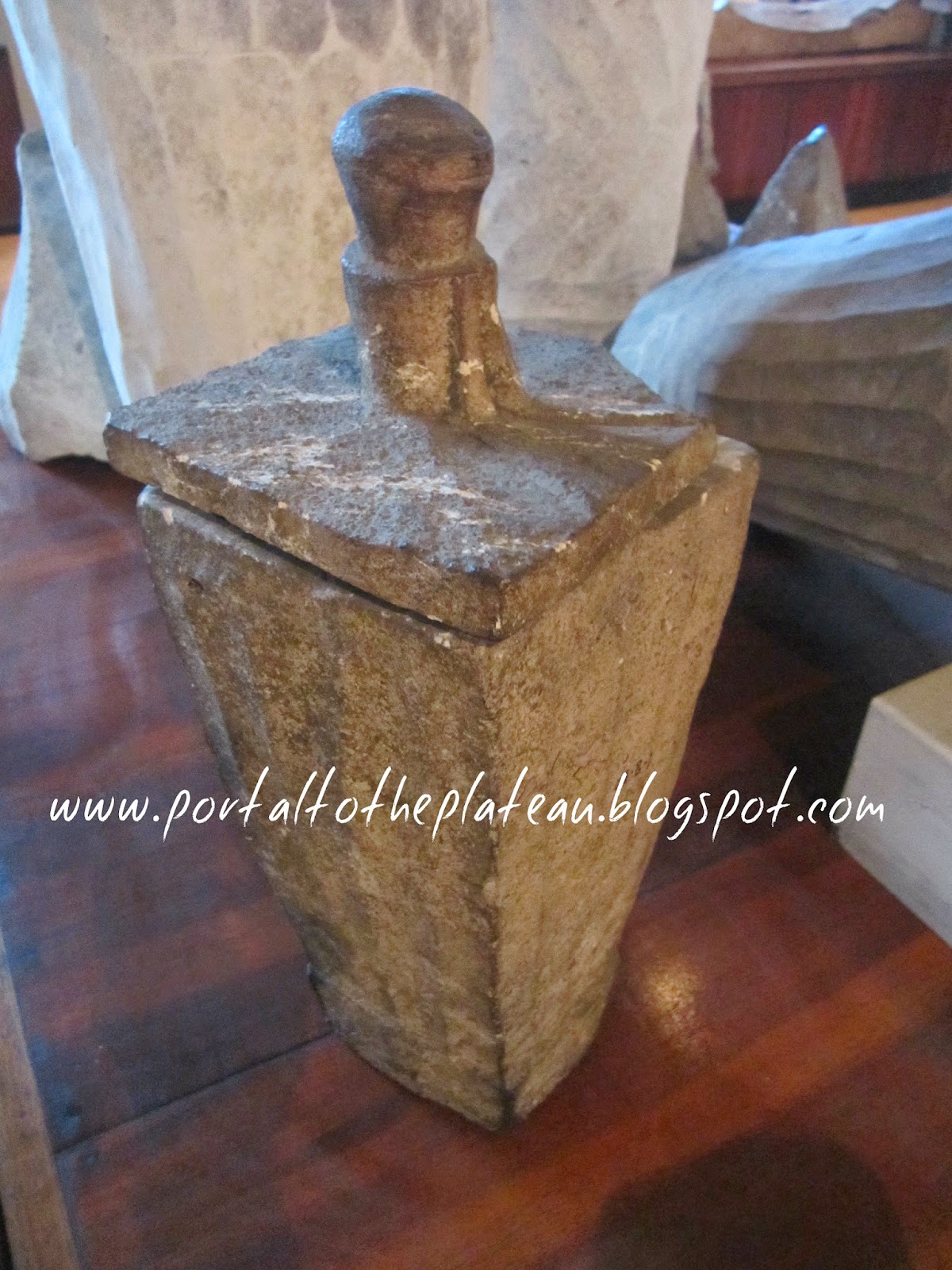
Burial Jar in Provincial Museum

I'm back here in Sultan Kudarat, and as any self-respecting burial jar enthusiast would, the first thing I did was visit the provincial museum and see the Kulaman burial jar in its collection.

I had heard on Facebook how disappointing the museum was, so I was no longer surprised when I found out it barely had anything on display. The two-story modest-sized building, some fifty meters behind the provincial capitol, was newly erected and tastefully designed. Inside, however, the museum only had the following: the Kulaman jar; an anthropomorphic clay figure, similar to the lids of the Maitum burial jars and maybe one of them; a jagged rock with streaks of gold; a made-of-clay kettle; and some brass Maguindanaoan musical instruments.

This is the provincial capitol, and the local museum is behind it.
The back gate might be closed, so take the unpaved road near
the entrance to the capitol but outside the concrete fence. 

The collection had no labels whatsoever, and the staff who was in the office was not sure when and how the items came into the possession of the provincial tourism office, but she knew that the burial jar was from the municipality of Senator Ninoy Aquino.

What mildly surprised me about the jar was its size. Among the burial jars I had seen, it was one of the largest and probably had the widest base. Each side of the square base must be at least 15 inches in length. The height of the jar, not counting the lid, was around 36 inches.

The Kulaman burial jar is one of the very few items
in the museum. Below, I took photos of my hand and foot
so that you would have some idea how large the jar is.

The jar looked like a tall rectangular box, and its lid was a plain pyramid. From the tip of the lid to the base, the artifact was covered with simple diagonal lines that formed diamonds. It might have been excavated from Senator Ninoy Aquino because the ones that were found in Lebak mostly had round bodies and human-shaped lids. I've seen Kulaman jars of various sizes and shapes, and the one in the provincial museum is now one of my favorite. It's simple, and its chipped lid notwithstanding, it's sturdy—something that has survived more than a thousand years and could seemingly survive thousands more.

Sunday, March 23, 2014

Dulangan Song for the Dead?

If you search "Dulangan Manobo" on Youtube, one of the top results would be a video that claims to feature a song for the dead of the Dulangan Manobo. The video shows two women in tribal garb, their backs on the camera, facing a coffin and singing in a tongue that would have been mellifluous had the circumstances been different. I had goosebumps while watching the video. Also, one question kept bothering me: Are the singing women really Dulangan Manobo, or is the video erroneously labeled?


I know a very few Dulangan words and I've heard some Dulangan speak among themselves using their own tongues, but my knowledge and experience is not enough for me to determine if the language in the video is indeed Dulangan. The setting itself is suspect. The wake is that of a non-Manobo man—a Christian, to use the word loosely—who had probably endeared himself to the tribal people while he was alive, so the scene is not a traditional lumad funeral. The deceased, a former communist leader and later government official, might have engaged with a lumad community for some time, but the tribe was probably B'laan, not Dulangan Manobo, as one short biography of his states. Lastly, the clothes the women in the video are wearing, though tribal, do not seem Dulangan to me. The long-sleeved blouse of one woman is bright gold, and Dulangan women rarely wear such a color. The patterns of the skirts are also a little too fancy. They must be malong from Indonesia or Marikina.

At the end of the video, one of the women explained to the other mourners the meaning of the song. The audio is not very good, but I can figure out enough words to judge that she's speaking in Hiligaynon with a thick tribal accent, and she is speaking the same way the Dulangan of Kulaman do when they use Hiligaynon! The singers for the dead might indeed be Dulangan. I'm confused.