Showing posts with label Manobo accessories. Show all posts

Friday, April 1, 2016

Bamboo Cases for Betel Quid

Let me admit it at the outset: I don’t know the correct Manobo name for the object that I’m going to feature today. This is quite a failure on my part as a researcher, considering my claim that the object is my favorite among the displayed items in Delesan Menubo. The object is a tiny bamboo stem used by Manobo men as a container for their betel quid. Each one has an accompanying lid, apparently fashioned from the same stem. If it were made of plastic, it can be easily mistaken for a lipstick case, albeit fatter.

What I like about the tiny bamboo case is the design on its surface. The design is carved on the bamboo with probably the tip of a penknife, and each case has a unique design. If you look closely, you can see that the design is composed only of simple geometric cuts, but when viewed as a whole, the cuts make the bamboo case a work of art. The design looks so intricate that I want to have a collection of these betel quid containers. One of the cases displayed in Delesan Menubo even has braided strips of black vine wrapped around it as an additional decoration.

I thought the name of the object is fuyot, which is described in the Kitab (Dulangan Manobo Customary Law) as “gamit ng lalaki lalagyan ng mama” (men’s container for betel quid). My other sources state, however, that a fuyot is a small drawstring bag. Maybe anything that is used to keep betel quid is called fuyot. When I asked the Manobo girls in Delesan Menubo what a fuyot was, I think some of them pointed a cloth bag and some of them pointed the tiny bamboo cases. I have to look for a Dulangan Manobo again to verify these things. For now, let me show you the three bamboo cases on display in Delesan Menubo.


Update: I've learned that the tiny case is called a selapa. I wrote the post in November 2015, and I asked a Manobo woman for the correct term in January 2016.

(Blogger's note: This post is part of a series on items that the Dulangan Manobo people traditionally use in their daily lives. Special thanks to the RNDM nuns assigned in Kulaman Plateau. For more information about the series, read my introductory post or click the label Delesan Menubo below.)

Friday, March 25, 2016

Manobo Bags

My hometown named its annual festival after the solok, but the Manobo basket I like most is the kelepi, shown in this photo. To know the different types of Manobo baskets, check out my post the previous Friday.

I failed to properly identify this bag displayed in Delesan Menubo. Among my list of Manobo baskets, the description of a kampilu is the closest to this bag: “oval, vine, tightly woven, large.” This bag, though, is made of reed instead of vine. Based on the description, a kampilu should look like a huge kelepi, but I didn’t see any such basket in the display room. Thus, for now, I’m calling this object a kampilu.

(Blogger's note: This post is part of a series on items that the Dulangan Manobo people traditionally use in their daily lives. Special thanks to the RNDM nuns assigned in Kulaman Plateau. For more information about the series, read my introductory post or click the label Delesan Menubo below.)

Friday, March 11, 2016

Manobo Pouches

Traditional Manobo men own a cloth bag called puyot, into which they put their betel quid and other important things. According to Defending the Land, a book on ancestral domain claims in Mindanao, a puyot is “usually colored blue” and “slung around [the] forehead even in plowing the field, to reach out to while resting from the task.

The other puyot displayed in Delesan Menubo is plaid and looks more “tribal.” Its string is also made of abaca, a native fiber. The string of the blue puyot, shown in the first photo above, is made of a synthetic material.

Just like how they wear their tubaw, Manobo men wear their puyot as they please. This grandfather prefers to sling the string on his shoulder and keep the cloth bag on his chest.

(Blogger's note: This post is part of a series on items that the Dulangan Manobo people traditionally use in their daily lives. Special thanks to the RNDM nuns assigned in Kulaman Plateau. For more information about the series, read my introductory post or click the label Delesan Menubo below.)

Friday, February 26, 2016

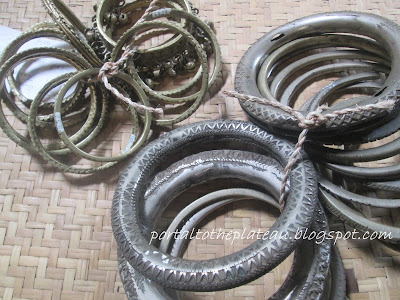
Manobo Bracelets and Anklets

You can tell a sugot (bracelet) from a sigkil (anklet) from their sizes.
The latter is normally bigger.

Sigkils go well with apol (tattoo).

Sugots may be made of nito, a native vine.

(Blogger's note: This post is part of a series on items that the Dulangan Manobo people traditionally use in their daily lives. Special thanks to the RNDM nuns assigned in Kulaman Plateau. For more information about the series, read my introductory post or click the label Delesan Menubo below.)

Friday, February 19, 2016

Manobo Belts

Binulan-bulan, a decorative belt for men

This belt, worn by Manobo women on special occasions, is part-ornament part-musical instrument. Each of the tiny brass balls is hollow and contains a tinier ball inside. The bells chime when the wearer of the belt walks and dances.

Brass is expensive for the Manobos, so many of the women make do with belts that are made of beads and have a few brass bells only. The beaded belts, nonetheless, are beautiful on their own.

(Blogger's note: This post is part of a series on items that the Dulangan Manobo people traditionally use in their daily lives. Special thanks to the RNDM nuns assigned in Kulaman Plateau. For more information about the series, read my introductory post or click the label Delesan Menubo below.)

Friday, February 12, 2016

Manobo Necklaces

The basak (necklace) of Manobos is made normally of beads and tiny brass bells and sometimes of animal teeth. 

Another sample of a basak worn by Manobo women. Men rarely wear necklaces, and when they do, theirs are usually much simpler.

Not all basaks are large and flashy. I bought these simple ones for some friends.

(Blogger's note: This post is part of a series on items that the Dulangan Manobo people traditionally use in their daily lives. Special thanks to the RNDM nuns assigned in Kulaman Plateau. For more information about the series, read my introductory post or click the label Delesan Menubo below.)
Friday, February 5, 2016

Manobo Earrings

Tunggal (large hoop earring) is one of the distinctive ornaments of Manobo women. The earring is worn in a series, the smallest hanging from the top of the ear and the biggest hanging from the earlobe. Manobo men used to wear tunggals too, but they stopped due to the influence of Christian migrants from Luzon and Visayas.

Suffering for the sake of beauty. Tunggals have caused the ears of this Manobo woman to swell and be deformed.


Simple mechanism. The brass loop is inserted through the hole in the ear. The two ends of the loop are then joined inside a bead.

(Blogger's note: This post is part of a series on items that the Dulangan Manobo people traditionally use in their daily lives. Special thanks to the RNDM nuns assigned in Kulaman Plateau. For more information about the series, read my introductory post or click the label Delesan Menubo below.)

Friday, January 29, 2016

Manobo Head Ornaments

In Dulangan Manobo, the general term for a headdress is kemage.
If it is attached to a comb, it is called a sudong.

A sudong

A kemage

A pakul (hair tie)

(Blogger's note: This post is part of a series on items that the Dulangan Manobo people traditionally use in their daily lives. Special thanks to the RNDM nuns assigned in Kulaman Plateau. For more information about the series, read my introductory post or click the label Delesan Menubo below.)

Friday, January 22, 2016

Manobo Accessories

The following are the names of personal adornments that the Dulangan Manobo people traditionally use: tubaw (head scarf, for male chieftains usually), tedong (cloth head covering), sayap (hat), sapeyo (cap), kemage (headdress), sudong (headdress with comb), pakul (hair tie), tunggal (earring), basak (necklace), sugot (bracelet), tising (ring), sabitan (belt), sigkil (brass anklet), and tekes (beaded anklet for men). In the coming Fridays, some of these items will be individually featured on this blog.

I want to have whatever it is that is hanging from the head of the guy
in this photo. 

I like the supermodel mien of this Manobo girl.
She’s playing a togo, a bamboo harp.

(Blogger's note: This post is part of a series on items that the Dulangan Manobo people traditionally use in their daily lives. Special thanks to the RNDM nuns assigned in Kulaman Plateau. For more information about the series, read my introductory post or click the label Delesan Menubo below.)