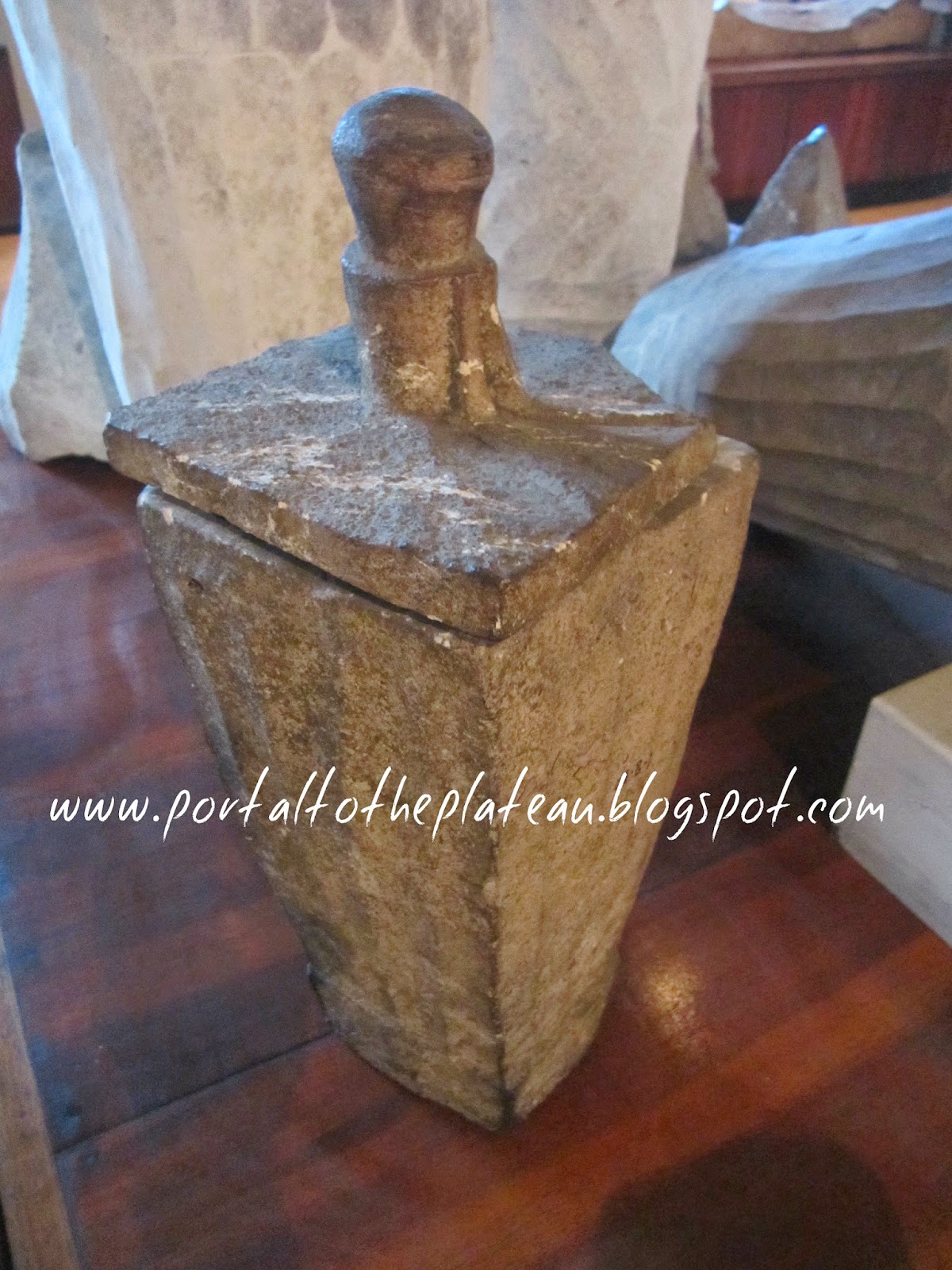
Showing posts with label burial jars. Show all posts

Friday, January 1, 2021

Fake Burial Jars

I found out a few days ago that the Kulaman Plateau burial jars at the Silahis Gallery in Intramuros in Manila have been sold out, and I have to apologize to the collectors in case they were encouraged to buy the jars after reading this blog. As I have not been posting here for a couple of years now, I wasn’t able to share with the public an important update: fake Kulaman Plateau burial jars do exist, and they probably include the items at the Silahis Gallery.

I learned about the existence of fake jars when I was involved in a tourism-related project at the municipality of Lebak here in the province of Sultan Kudarat. Here’s what I wrote in the report that I had to submit:

“At around 2 PM on July 10, 2018, the writer, together with other members of the research team, dropped by the barangay hall of Keytodac and had a conversation with some local officials who happened to be in the office. The writer heard for the first time the existence of fake burial jars. The informant named the counterfeiter. But names are withheld here because the information has not been confirmed.

“After about an hour, the team proceeded to the barangay hall of Salangsang, where another informant told the team of the existence of fake burial jars. The informant named three counterfeiters, who were in business in the first decade of the twenty-first century. The informant also said that the counterfeiters would soak the fake burial jars in water with urea to speed up the growth of algae and make the jars look old and authentic.

“Apparently, counterfeiting of burial jars and selling them to private collectors is an open secret in the southern mountains of Lebak.

“This writer has strong reasons to believe that there was truth to the statements of the informants. He has seen burial jars that are purportedly from Sultan Kudarat but looks dubious, primarily because their designs stray too much from the typical features of burial jars as scholars noted. In Silahis Gallery, a souvenir shop inside Intramuros in Manila, one cover in the collection has a figure of a carabao head. In contrast, burial jars discovered in the San Carlos and Silliman explorations are mostly anthropomorphic. The scholars believe the figures indicate the sex of the deceased kept in the jar. Applying the theory, the carabao-shaped figure would indicate that the bones inside the jar are that of a carabao’s. This is preposterous, and the burial jar must have been made by an amateur counterfeiter.

“The jars that are on display inside the Tourism Office of the Municipality of Lebak might also be counterfeit because some of them have animal-like instead of anthropomorphic figures.

“Another possible indication of forgery is well-defined and intricate incisions, possible only with the use of modern tools. Authentic burial jars were carved out of blocks of limestones using crude implements, and because the jars have been left in natural surroundings for around 1,500 years, it is natural for their surfaces to have been weathered.

“Lastly, burial jars that are as small as a typical flower vase must be forgery, too. They are too small to contain human bones, even that of an infant’s.

“The existence of fake burial jars make it difficult for anyone to determine the authenticity of all the burial jars. Only the jars that have been recorded by anthropologists in 1960s and properly tracked can be safely declared authentic. On the other hand, the existence of fake burial jars could make black market buyers suspicious of burial jars claimed to be from Sultan Kudarat, and this could discourage trading of the artifacts.”

(In photo: Me with a collection of burial jars at the municipal hall of Lebak, Sultan Kudarat. Some of these jars may be fake. Its now difficult to determine the authenticity of Kulaman Plateau burial jars because, I found out in a visit at the municipality, counterfeits were made in the aughties.)

Tuesday, May 9, 2017

Kulaman Burial Jars in Laan Magazine

Another important thing that happened last year is that the burial jars of Kulaman Plateau was featured in the maiden issue of Laan, a regional travel and advertising magazine, and the article, of course, was written by this blogger.

The magazine generously gave my article a whole spread and half a page, and copies of the magazine were distributed in government agencies and business establishments, and tucked in the seats of the Executive Class units of Yellow Bus Line, a la Smile magazine of Cebu Pacific airline.

I wasn’t able to attend the launch, so I don’t have my own copy of Laan, and I don’t have my own photos of the article. But below are the cover page and the contributors’ page, which I grabbed from the Facebook account of the magazine. My special thanks to Louie Pacardo, the managing editor and a fellow blogger, for asking me to contribute.


Monday, May 8, 2017

Kulaman Burial Jars in Tau SOX Festival


I’m back, after almost a year of not touching this blog. (My “latest” posts, dated half a year ago, had been prescheduled.) I can’t promise to blog regularly again, but I will post important updates.

I’ve been preoccupied with a lot of other matters, especially literary activities. Other local writers and I, I’m proud to say, have done many things, most of which were firsts. We formed writers associations, albeit informal for now. We created Cotabato Literary Journal, a monthly online publication. And we organized several poetry readings and writing seminars. I was also diagnosed with panic disorder, and I’m still on medication up to now. (But don’t worry, I’ve gotten so much better.)

As to the updates I must share with you, let me start with Tau SOX: Festival of the First Peoples, organized last year by the regional office of the Department of Tourism. The one-week event aimed to highlight SOX (short for SOCCSKSARGEN) as a land where early men (tau) lived. The organizers invited me to give a talk on the limestone burial jars of Kulaman Plateau, in a forum that also included a talk on the clay burial jars of Maitum and a talk on the burial practices of Tedurays.

I wasn’t able to take good photos and extensive notes of the event, so if you want to know more about it, check out the news article on NDBC and the post by local blogger Hajar Kabalu. Truth be told, I had a very small audience, even if the venue was the activity center of a mall. It was past lunchtime when it was my turn to speak, and most attendees had gone somewhere else. Nonetheless, I believe the right people stayed and listened, and I’m glad for the opportunity to spread more awareness of Kulaman burial jars.

Friday, August 12, 2016

The Silahis 14

I can’t afford to buy the limestone burial jars that are for sale and then donate them to the province of Sultan Kudarat or any of the municipalities in Kulaman Plateau, so I’ll just keep track of them. Hopefully, they will all find their way back home. Below are the jars that are on display in Silahis Arts and Artifacts, located at 744 Calle Real del Palacio (General Luna), Intramuros, Manila.


1—This quadrangular jar has V-shaped and diamond patterns on the sides. The lid is shaped like a gable, but half of the top part is cut off to give way to a tiny figure of a head. The eyes, nose, and mouth of the figure are excavated.
2—This conical jar is flat at the base and has vertical flutings around the body. The lid is circular and flat at the base, which supports a knob that looks like an inverted drinking glass.
3— This quadrangular jar has V-shaped patterns on the sides. The lid is shaped like a gable. The surface of the jar and the lid is brown probably from being buried in dirt. Some parts are black, as if exposed to smoke.
4—This jar is shaped like a box with uneven and vague vertical flutings. The lid is shaped like a gable and has parallel vertical flutings. The body of the jar looks newer than the lid. It is in fact so white and shiny that I suspect it’s just a few decades old at most.
5—This quadrangular jar has a clean surface and rough in some parts. The lid is smooth, shaped like a pyramid, and has triangular drawings; one corner of it, however, is missing.
6—This boxlike jar is slightly smaller at the base. The sides have diamond designs. The lid is quadrangular and flat with a bas-relief of a carabao head, which is highly unusual, for none of the burial jars that were excavated by anthropologists in 1960s has a carving of an animal in the lid. Some of the anthropomorphic figures look like animals, but they’re obviously meant to be not purely animal. I doubt if this item has really been used as a burial jar. The surface is clean and smooth all over. Modern tools must have been used in carving the stone.
7—This small jar looks like a big vase. It has no lid. The surface is decorated by deep diagonal cuts that look like lines of dashes. Each cut is oblong and tapers on both ends.
8—This boxlike jar is smaller at the base and has a wide mouth. The lid is shaped like a gable topped with a short, wide, and rectangular handle. The surface is brown from dirt and doesn’t have any geometric designs.
9—This quadrangular jar goes wider as it goes higher. The lid is square and flat. The surface doesn’t have any geometric designs. This must be the most minimalist jar I’ve ever seen.
10—This short cylindrical jar has vertical flutings. The lid is shaped like an inverted bowl and has a small figure of a human head on top.
11—This cylindrical jar has wide vertical flutings. The lid has a circular lower half and a gable-shaped upper half.
12—This conical jar is flat at the base and has shallow vertical flutings. The lid is circular, flat, and has flutings from the center to the sides.
13—This quadrangular jar has vertical and arrow-like flutings on the sides. The lid is square, flat, and topped with a short cylinder that has vertical flutings.
14—This quadrangular jar has diamond-shaped carvings all over, including the gable-shaped lid.

(Update: These jars may be fake. Check out this post for the explanation.)

Friday, August 5, 2016

Kulaman Jars in Intramuros

I utter “oh” and “wow” under my breath as I point my camera to the display case and press the shutter button every half a second. “You’re like a thirty-something dad who collects toy trains,” says my friend Reno beside me. “You’re so charged up.”

I chuckle. Indeed, I’m looking at objects that I’ve been wanting to see for a long time and I’ve been spending considerable time and resources on. They’re not toy trains, however. They’re not fancy toys or expensive gadgets or anything weird but still somehow not so weird. They’re just plain weird, for most people. The objects in the display case are burial jars—made of soft stone, about 1,500 years old, and taken from Kulaman Plateau. Reno and I are in the Museum of the Filipino People.

Reno and I are supposed to check out the other galleries in the museum and to drop by the National Museum across the street, but we’re pressed for time. It’s past four in the afternoon, and I want to see all the Kulaman burial jars that I can see that day, so we skip our other destinations and ride a pedicab straight to Silahis Arts and Artifacts, a private gallery inside Intramuros.

When we step inside Silahis, I ask at the front desk where the limestone burial jars are displayed. I’m told that the artifacts are on the third floor. Reno and I walk upstairs without inspecting the other items, mostly native handicrafts, in the jam-packed gallery. The scene earlier is repeated; I take out my digital camera and take photos like I’ll never see the burial jars again. Silahis Arts and Artifacts has fourteen in its collection, and all save for the smallest one is complete—meaning, they have lids.

Scotch-taped on the jars are large cards, and the cards don’t look good in my photos, so before I take the photo of each jar, I remove the piece of paper and put it where the lens won’t catch it. After a while, I pick up some of the cards to reattach them to the jars. I’m flabbergasted. I thought the cards merely contain a general description of the jars. I read them and find out that at the bottom of each is a price. Now I don’t know which card belongs to which jar. Reno chuckles. Hastily, I put a card each on the jars without attempting to be accurate. It’s difficult to try, anyway. Most of the jars have the same size and priced at P4,000, P5,000, or P,6000. It’s not easy to tell which jar should be P1,000 or P2,000 more expensive.


“They’re cheap!” says Reno upon learning the prices. I think the same way. Some of Kulaman jars that have been taken to the U.S. are offered for sale online for at least $2,500. “This one especially,” adds Reno, pointing to a coverless jar that is much smaller than the rest and priced at P500 only. The label erroneously describes the jar as a “vase.” We compute the total cost of all fourteen jars. Two of the jars do not have price tags, but their sizes are average, so they probably cost P6,000 each at most. One or two of the jars cost P7,000 or P8,000. One jar, by far the biggest in the collection, costs P20,000. The total amount is no more than P90,000. “I can buy all these without asking money from my parents,” says Reno.

I’m a bum and not as rich as Reno, but I have enough extra money in my wallet to get myself one of the medium-sized jars, in addition of course to the “vase,” which is simply a steal. I’m having a serious moral dilemma. I told myself before that I should just write about the limestone jars and maybe convince all their current possessors to give them back to the province of Sultan Kudarat. I should not be involved in the trading of the jars. I should not acquire by any means even just one burial jar for the living room at home. But I tell myself that I won’t commit any sin if I buy the “vase” and another jar and then donate them to Delesan Menubo, a display room operated by Catholic nuns in the municipality of Senator Ninoy Aquino.

I continue taking photos while talking to Reno and mulling over buying some burial jars. From behind me, a stern voice asks, “Para sa ano yan?” (What is that for?) I turn and see a middle-aged woman in some kind of uniform. Her face is serious, and her arms are folded on her chest. I assume she’s an employee of the gallery. “Sa blog ko lang po,” I answer. “OK lang ba?” She doesn’t answer and then walks away. Reno and I resume talking about the burial jars and other things.

I begin to lose interest in buying the jars. It occurs to me that transporting archaeological artifacts might require special permits and I might be held in the airport if the scanners show I have suspicious rocks in my luggage. I have not checked the laws on cultural treasures and similar stuff. Besides, it seems better to stick to my original plan and be not involved at all in any financial deals involving burial jars.


I would probably not think of such matters if the gallery attendant had been friendlier. She has irked me. But she can’t stop me from taking several photos more after the dozens that I’ve taken. These burial jars belong to my province. The people of my province have more right to the jars than the owners and employees of the gallery. I take out my camera and click away again.

Para sa ano yan? ” the woman asks me again from behind after a while. I thought she has left me and the burial jars in peace. I explain again that it’s just for my blog. “Bawal po ba (Is it prohibited)?” I ask. “Have you asked permission downstairs?” she says in Tagalog. “Hindi po,” I admit. She asks a few more questions, and I answer them honestly and politely. I tell her researching about the jars is my personal hobby. She must have noticed that I’m a perfectly decent or sane person after all. We keep on talking, and after a while, as though another spirit has possessed her body, she becomes accommodating, sympathetic even. She tells me the jars have been in the gallery for maybe ten years and she believes they should not have been for sale because burial jars used for the dead. My irritation with her dissipates. All the same, I have lost interest in buying jars or anything else from the gallery.

I have nothing but photos of the fourteen jars. If I write about them in my blog, if I tell the public about them, some private collectors might become interested and buy them and hide them away forever from the people of Kulaman Plateau and even of the Philippines. If more people become interested in the jars, they might fetch a higher price in the black market. I’m not sure if I’m doing the right thing by writing about them, but I’m a writer, and my duty is to write. Some things are beyond my control, and there are some risks that I have to take.


(Update: These jars may be fake. Check out this post for the explanation.)

Monday, April 4, 2016

Jar Covers in USC Museum

Like what Marcelino Maceda did in his article in the journal Anthropos, I’m going to list here some burial jar covers and their respective descriptions. My original plan was to compare the list in Maceda’s article and the displayed items in the University of San Carlos Museum. Maceda selected thirty-five jar covers to include in the paper, and the university museum only has twenty-one now in its collection. I wanted to know which of the twenty-one were included in the thirty-five. The task, however, was headache-inducing. I decided to do the comparison some other time and focus instead on the museum collection.

Unlike what Maceda did, I can’t give you exact measurements of the jar covers. I’m basing my descriptions on the photos that I took more than three years ago. I assigned numbers on the artifacts based on how they were displayed when I took the photos. Two of the covers still serve their purpose because the jars they were made for have survived. I numbered the two last. Jar Cover No. 21 is shown in the second and third photo below, but I can’t put a number on it because the number icons in PhotoScape, the photo-editing software I used, are up to 20 only.


1—This is round and flat.
2—This is shaped like a gable and rectangular at the base.
3—This is shaped like an inverted bowl and decorated with honeycomb figures from the base to the top.
4—This is round and flat at the base, on which stands a phallus.
5—This is round and thick at the base, on which stands a short pole. The pole is decorated with honeycomb figures.
6—This is circular, squat, and shaped like a stopper for a bottle.
7—This is round and thick at the base, on which stands a short pole that is phallic at the top.
8—This looks like a bust, but the head is shaped like a diamond. On the chest, two tiny arms are carved. The arms look as though the person is touching his her heart.
9—This is shaped like an inverted bowl at the base and phallic from the middle to the top. Eyes, nose, and ears are carved on the glans penis.
10—This is shaped like an inverted bowl at the base. Two legs are carved on the base, and there’s a tiny protrusion between them, probably representing a penis. The base extends upward into a short pole, which is broken. The figure attached on top of the pole may be from another specimen because its color is not same. The figure is shaped like a neck and a head of a human being, with excavated eyes, ears, and mouth.
11—This is a bust of a man. The base is circular and shaped like an inverted bowl. The arms of the figure are embossed and form a semicircle. Three straight grooves run from the neck of the figure to the edge of the base. The head looks like a real person, with the eyes and mouth excavated and the nose and ears embossed.
12—This is a pyramid but has a circular base.
13—This is shaped like a standing human being, but the legs are merely carved on the base, which looks like an inverted bowl. The figure is as humanlike as a doll, but the left arm is missing.
14—This is flat and circular at the base, which supports a figure of a person’s upper body. The frontal part of the figure appears to have crumbled.
15—This looks like an elongated gable. On one side is an embossed outline of a human body, but the arms and legs stretch outward before curving down. The fingers and toes are large and long.
16—This is circular and nearly flat at the base, which supports a short pole that slightly goes smaller in circumference as it goes higher. A ropelike protrusion goes around the pole in the middle, making the pole look as though it has two layers. Spiral flutings decorate the base, and vertical flutings decorate the pole.
17—This is circular and thick yet flat at the base. Jutting from the base is a short knob that goes wider as it goes higher. Simple straight flutings decorate the sides of the knob and the top surface of the base.
18—This is round and flat at the base, which supports a large figure of a neck and a man’s head. The eyes, the holes of the nose, and the mouth are excavated, and the ears are slightly embossed.
19—This is shaped like a gable and nearly square at the base. The diamond-like cut at the top of the gable is probably a yoni.
20—This is shaped like a gable. On one side, it has a figure of a human being that resembles a lizard. The figure has a tail, and the arms and legs are splayed out. The head has holes representing eyes and a mouth. I don’t have a good photo of the other side of the lid, but according to Maceda’s journal article, the other side has a similar figure but without a tail.
21—This is square, thin, and flat at the base, which supports a short pole with a glans penis at the top. The glans penis has holes that represent a person’s eyes, nostrils, and mouth. Arms that look like limbs of a lizard are carved from just below the glans penis down to the length of the pole and the top surface of the base until they reach the edge.

Monday, March 28, 2016

Jar Covers that Depict Shamans

It’s common knowledge that the people who lived a long time ago considered the shaman an important part of the community. The shaman could be as powerful as the chieftain and could even be the chieftain himself. So if the shaman died, it was perhaps only fitting for the people to remember or try to immortalize him for his significant role. Apparently, this is what the burial jar people did about 1,500 years ago. In a paper, anthropologist Marcelino Maceda states that some jar covers found in Kulaman Plateau indicate that the bones inside the jars are that of a tribal priest or medicine man.

Maceda presents thirty-five jar covers in the paper, and three of these, though anthropomorphic like most of the others, have uncanny shapes or markings. They are listed below. The first number in each item reflects the number of the artifact as it appears in the paper, and the second number is the field or museum number. (KN stands for Kan-Nitong Cave.) Also included are relevant portions of Maceda’s descriptions of the jar covers.

9. M-C0007 (KN)
[This gable-shaped cover has] two bas-relief anthropomorphic figures. The first figure is a human resembling a flying lizard.

16. KN-16-0188
The . . . anthropomorphic figure assumes a snake-like or lizard-shaped human head. . . . The face is triangular; the ears extend from the top of the head down to the level of the lower part of the jar and are similar to the hood of a cobra. . . . This figure may represent a shaman who could change his face at will or a medicine man whose forte is curing snake bites.

17. M-00018 (KN)
The figure has a pointed head arising from two triangular ears. . . . This anthropomorphic figure is probably that of a shaman who could change from one form to another, i.e., to a lizard or snake.

I like Maceda’s interpretations of the designs of the three jar covers. Shamans fascinate me; several of the short stories I’ve written have shamans in them. I wonder, though, if Maceda is being too imaginative in the case of Jar Cover No. 16. The ears that are “similar to the hood of a cobra” may just be enlarged thyroid glands. Goiter is not uncommon among present-day Dulangan Manobos due to nutritional deficiency in their diet. The case must have been worse among the burial jar people about 1,500 years ago. It’s possible that the jar cover is simply depicting an ordinary tribesman with an ordinary affliction, not a leader with supernatural abilities. We can’t know for sure. For now, we can only speculate. Everyone can be an expert. Further research should be done on the burial jars. The items that have been discovered should be reviewed in light of more recent archaeological findings, and Kulaman Plateau should be explored again for possible burial sites that have not been disturbed yet.

M-C0007 (no. 9 in Maceda’s paper) has a figure of a human being
resembling a lizard, probably indicating that the person
buried in the jar was a shaman or magician.

Monday, March 21, 2016

Jar Covers that Indicate Age

Marcelino Maceda, the first anthropologist to formally study the limestone burial jars of Kulaman Plateau, says in a paper that the lines in some of the jar covers may not be merely decorative. He believes that they might be an indication of the age of the person buried in the jar. Such markings are found in six of the thirty-five jar covers that Maceda discusses in the paper. They are listed below. The first number in each item reflects the number of the artifact as it appears in the paper. The second number is the field or museum number. KN stands for Kan-Nitong Cave, and FE stands for Fenefe Cave. I also added Maceda’s descriptions of the features that possibly indicate age.

8. KN-17-A—small and has six flutings on one side of the gable, possibly for a female child
14. KN-11-A—has a line drawing of a human with a vulva on one side of the gable and has angular cuts at the corner of the gable
15. KN-12-0142—shaped like the head of a man and has twenty-five parallel flutings covering the base
20. KN-45-0330—has fifteen large serrations and twenty-one small ones at the top of the gable
26. KN-49-0134—has ten to eleven angular cuts on the corners of the gable, possibly for two young females
33. KN-34-0221 20—has twenty flutings at the base of the pagoda

KN-12-0142 (no. 15 in Maceda’s paper) has twenty-five parallel flutings at the base, just below the neck (barely visible in the photo). Maceda believes the flutings may represent the age of the man buried in the jar.

Monday, March 14, 2016

Jar Covers that Indicate Sex

Look at the base of the jar cover, specifically at the dot-like protrusion between the leg-like carvings. The protrusion indicates that the person buried in the jar was male. On the left-hand corner of the photo is KN-9 (no. 25 in Maceda’s paper), an amalgamation of human head and glans penis.

When I was still working in Cebu, I once joked to an officemate that my hometown—Kulaman Plateau—had 1,500-year-old dildos. I was referring, of course, to the phallus-shaped lids of some of the limestone jars. I never repeated that joke on social media, even if I was fond at the time of posting on Facebook almost everything that was happening in my life, simply because I thought it was inappropriate. The jars, after all, were used for burial and therefore sacred. Now, though, I’m making that joke public because I realized, after thoroughly reading a paper by anthropologist Marcelino Maceda, that it wasn’t my mind’s fault if it associated some of the jar covers with human sex organs. I learned from the paper that, indeed, the jar covers might have been made phallic deliberately. For the carvers 1,500 years ago, because they didn’t have a system of writing yet, the best way to indicate the sex of dead people was to draw or carve their sex organs on the jars that they had been buried in.

In the paper “Preliminary Studies of the Figures and Ornamentation of Some Selected Jar Covers from Kulaman Plateau (Southwestern Cotabato), Island of Mindanao, Philippines,” published in Anthropos in 1967, Maceda states that of the thirty-five selected jar covers, more than half indicates whether the remains inside them belong to a male or female individual. Fourteen of the covers appear to point out that they contain men. They are listed below. The first number in each item reflects the number of the artifact as it appears in Maceda’s paper. The second number is the field or museum number. KN stands for Kan-Nitong Cave, and FE stands for Fenefe Cave.

9. M-C0007 (KN)—shaped like a gable, has a bas-relief of a human resembling a flying lizard, assumed to depict a shaman
11. KN-20-0128—shaped like a standing human being with a lingam between the thighs
13. KN-34-0265—realistic bust of a male child
15. KN-12-0142—shaped like a human head, size and look seems to depict an important man
16. KN-16-0188—shaped like a human head with something that resembles the hood of a cobra, assumed to depict a shaman
17. M-00018 (KN)—shaped like a human head but with triangular forehead and ears, assumed to depict a shaman
18. FE-11-8—shaped like a standing human being with a hanging chin that possibly depicts a beard and whiskers, with additional line drawing of a human figure at the back
21. M-C003 (FE)—shaped like a human head, with “realistic” features
22. KN-34-0166—human bust “probably” representing “a young male specimen”
23. KN-49-A—made of clay, shaped like a human being leaning backward, possibly representing a leader or a child (due to its smallness) watching an event
24. M-001 (FE)—shaped like a human head with a haughty expression, probably depicting a male leader
25. KN-9—phallic with features of a human face on one side
27. M-C005—phallic with features of a human face on one side
28. KN-5-0102—phallic with features of a human face on one side

The paper also states that number 7, KN-15-0294, “indicates that the bones contained in the jar were those of a male individual.” I wonder if the specified is a typographical error. The paper states that the cover is gable-shaped and the human figure on one side of the gable has widespread legs. Maceda normally associates these features with female specimens, as in these nine jar covers:

2. KN-17-0164—shaped like a gable, with a human bas-relief that has widespread legs
3. KN-12-0157—shaped like a gable, with spiral fluting
4. KN-8-0015—shaped like a gable, with honeycomb figures
8. KN-17-A—shaped like a gable, with diamond figure incised on one side
14. KN-11-A—shaped like a gable, has abstraction of a human figure with a vulva, has another figure showing the buttocks of a woman with the yoni extending forward
19. KN-17-0166—shaped like a gable, with line drawings of human figures emphasizing breasts and buttocks
20. KN-45-0330—shaped like a gable, has “abstractions which may indicate a female specimen”
26. KN-49-0134—shaped like a pyramid, has lines representing two human figures, one of which has a double yoni and the other has one yoni
34. FE-X-24—shaped like a pyramid, has a line drawing of a woman with mammary glands, womb, and yoni

Not all the figures, of course, is clearly phallic or yonic. Number 12, KN-18-B, is shaped like a standing human being with a lingam between four legs, indicating two men, a couple, or twins. Number 10, KN-50-103, has “a figure at its lower part which is a line drawing of a woman with buttocks emphasized,” and “a stick figure with an excavated female genitalia is found a little lower than where the two feet almost meet.” Maceda believes that number 10 is the cover of a jar containing a specimen of an intersexed individual. If he is right, the lid must be the oldest record in Philippine history about homosexuality.

Maceda believes that the widespread legs of the figure in KN-17-0164 indicate that a woman was buried in the jar. He also believes that gable-shaped jar covers, resembling houses, were used for women.

Monday, March 7, 2016

Ten Discoveries from Maceda’s Paper

The jars that anthropologist Marcelino Maceda studied are now on display
at the University of San Carlos Museum, in Cebu City.

I can’t emphasize enough the value of the research papers written by anthropologist Marcelino Maceda. Reading them has made me understand better and appreciate more the limestone burial jars of Kulaman Plateau. One article alone—specifically “Preliminary Studies of the Figures and Ornamentation of Some Selected Jar Covers from Kulaman Plateau (Southwestern Cotabato), Island of Mindanao, Philippines,” published in Anthropos in 1967—has given me so much information. Many of what I learned from the paper are new to me, and some confirm what I have known or conjectured before. The following are ten of the facts that fascinate me most:

1. The jars aren’t just made of limestone. Maceda says some of the jars are made of “young gypsum.” He therefore uses the general term soft stone in describing the jars. I might continue to use limestone though because it indicates right away that the jars are white.

2. Some of the jars are made of clay. Maceda believes the burial jar people might have used clay at first, but because clay was limited in the area, they turned to the huge blocks of stone in dry riverbeds. They were quite resourceful, weren’t they?

3. More than six hundred specimens were discovered. Maceda’s team explored two caves—Fenefe and Kan-Nitong—in the hamlet of Menteng, and they were able to dig up “burial jars (soft stone and clay) and covers, human bones, stone flakes and semi-polished stone tools, ornaments (made of ivory, clay, shell, and iron), animal bones and pottery (pots and shards).”

4. The Dulangan Manobo might not have made the jars. I’ve discussed this in my post the previous Monday, so I won’t repeat here the explanations.

5. The jars were being wet while carved with stone tools. Needless to say, carving the jars 1,500 years ago required a great doze of patience. The carvers only had polished stones as tools, so it was difficult to carve the blocks of stones. Fortunately for them, the stones are softer when wet, so while working the stones, the carvers “subjected [them] to a wetting process.”

6. The phallic designs were done on purpose. I’m not just being dirty-minded. Maceda says the designs of the jar covers are an attempt of the carvers to describe the dead person. Indeed, for nonliterate people, the best way to indicate a person’s sex is to draw or carve the shape of his sex organ. For female bodies, of course, the designs on the jar covers are yonic.

7. Lines may indicate age. Maceda says that the “flutings,” “angular cuts,” or “serrations” on some of the artifacts indicate the age of the specimens inside the jars when they died. Maceda observes this in six out of the thirty-five jar covers discussed in the article. He puts a question mark, however, in each of the statements about age, which means that he’s not really sure if the burial jar people had any system of writing numbers.

8. Some figures depict shape-shifting shamans. In three out of the thirty-five jar covers, Maceda observes in them anthropomorphic figures that may be depicting “culture heroes” who can assume the form of snakes or lizards. He believes that the jars possibly contain the bones of shamans, spirit mediums, and the like.

9. Maceda must be the first person to officially call Kulaman a plateau. The anthropologist says that his “companion informed him that somewhere in ‘Kulaman Valley’ were several caves” where jars had been seen. Maceda puts a number in superscript after Kulaman Valley and then explains in the footnote, “Actually this is a dissected plateau with an elevation of more than 2,000 feet. Hence, in the title and in the paper itself this is simply referred to as Kulaman Plateau.”

10. Some of jar covers look like a pagoda or stepped mountain. This is particularly surprising to me because I’ve never seen one in the museums I’ve been to. Maceda’s article includes a photo of two such jar covers. I wonder where they winded up. Not in the University of San Carlos Museum, for sure. My memory and my file photos tell me that there are no pagoda-like or stepped jar covers there.

Monday, February 29, 2016

‘Manobos Didn’t Make the Jars’

Late last year, I was finally able to read thoroughly the papers written by Marcelino Maceda, the anthropologist from Cebu who conducted the first scientific explorations of the archaeological sites in Kulaman Plateau. Three of the papers were published in Anthropos magazine in 1960s, and the three are currently available online on Jstor.org. I had long found access to the papers—I was quoting them in my posts as early as 2013—but I would only skim them for whatever information I needed. It was only around September last year when I had the leisure to read the whole text, from the introduction to the conclusion, from the title to the footnotes and list of references.

One of the things that I long knew but I have not mentioned in this blog is Maceda’s theory on who really made the limestone burial jars. In a 1967 paper, he states that it could not have been the Dulangan Manobos. Do I hear you gasping in shock now? Maceda says the burial practices of the present-day Dulangan Manobos do not involve secondary burial—in other words, they do not take out from the coffin or dig up their dead and move the bones to a receptacle—so they or their ancestors could not have carved the jars out of limestone. That’s Maceda’s main argument. You may read the paper for the supporting information.

Maceda says he has more reason to believe that the people who made the burial jars were “a part of the Malayo-Polynesian group that passed the Philippines on their way to the other islands of the Pacific.” He anchors his theory on researches made by other anthropologists. Now who am I to argue against men with PhD’s?

As far as I know also, as someone who grew up in Kulaman Plateau, the Dulangan Manobos do not practice secondary burial, but I want to believe that their ancestors did and the practice was just abandoned or forgotten some generations ago. I think this can be proven by a DNA test. If the DNA in the bones found in the burial jars has a high percentage of similarity to the DNA of the Dulangan Manobos living in the area today, then the jar makers might simply be the ancestors of the Dulangan Manobos. In any case, I won’t be surprised or disappointed if it’s proven some way that the jars are indeed a trace of a transient culture, a lost people. The Dulangan Manobos do not care much about the burial jars. In 1950s and 1960s, they were involved in the indiscriminate smuggling of the artifacts out of Kulaman Plateau and into the hands of greedy collectors. The Dulangan Manobos would not have sold the jars in such a scale if the jars had been sacred to them. Who would sell the bones of his ancestors?

I came across a lot of other interesting information in Maceda’s papers, and I’m going to share them with you in the coming weeks. I’ll be writing about the sexual images carved on the burial jars, why the sultan of Kulaman may not have the right to call himself so, and other related topics, if I have enough time and energy to write.

Monday, December 28, 2015

The Burial Jars Triangle


I wanted to create a map of some kind of where secondary burial in limestone jars were practiced. To my surprise, the map turned out to be more interesting than I had expected. When I identified the villages where there had been confirmed sightings of burial jars, I found out that the three villages could be connected by lines to form an almost perfect triangle. The area inside the triangle, being sparsely populated and largely forested, may have a number of burial caves still waiting to be discovered!

At the right-hand edge of the triangle is Barangay Kuden, Municipality of Senator Ninoy Aquino. That’s where an anthropologist from the University of San Carlos (Cebu) dug up burial jars in 1963–64. At the top of the triangle is Barangay Salangsang, Municipality of Lebak. That’s where anthropologists connected with Silliman Univeristy (Negros) dug up burial jars in 1965–66 and 1967–68. At the left-hand edge of the triangle is Barangay Nalilidan, Municipality of Kalamansig. That’s where burial jars have been found or can be found based on the socio-economic profile of Sultan Kudarat that the provincial government released in 2010.

I must admit that the information about Barangay Nalilidan is not very reliable. Even if the source is an official document, it contains quite a number of errors, both factual and typographical. I found the information on the “list of tourist spots by municipality/city.” Indicated beside “Nalilidan” is “Burial Urns,” along with “Sulfuric Hot Spring” and “Nalilidan Hot Spring.” To help you gauge the reliability of the list, here’s more information from the downloadable report: Indicated beside “Kuden” is “Burial Urns.” This is accurate, though Kuden has no burial jar collection to speak of, as I narrated in a previous post. Indicated beside “Salangsang” is “Salangsang Cave,” no “Burial Urns.” The cave is probably not the same cave where burial jars were found, for according to some published research papers, the cave is named “Seminoho.”

I’m also not a hundred percent sure of the exact location of Nalilidan in the map. The provincial map has no labels for barangays and sitios, so I had to compare it with Kalamansig’s municipal map, which has labels, all right, but barely legible in some parts. Though the two maps seem to coincide on the location of Nalilidan, they don’t on the locations of some other barangays, especially the poblacion—the seat of government, the most important barangay. How could you trust such maps?

All the same, I’m glad to have discovered that there might be burial jars in Kalamansig, and the location is near the coast, not very far from the paved national highway. It will be easier for me to research about them in case I find myself in Kalamansig one of these days.

Wednesday, December 2, 2015

The Creepiest Jar Cover

 This jar cover is creepy even if—or because—it looks
like a mini bust of Jose Rizal.

I know, of course, what burial jars are. They contain dead people. They contain exhumed bones of dead people. They’re small coffins. Despite this fact, they never gave me the creeps. Until I saw one jar cover in Museum of the Filipino People.

The jar cover is one of only three specimens from Kulaman Plateau. While the two others are jars with intact lids, this one is a lid only. It is made of limestone at the bottom and the middle and of clay at the top. It’s a bust. The base is shaped like an inverted bowl. The middle, forming the chest, is a simple short cylinder carved with tiny arms on the sides. The head part is what makes the artifact Halloween-y. It really looks like the face of a human being, and because the material has crumbled, it looks as though one of the eyes is winking at the onlooker and the mouth is forming a maniacal grin.

I wonder why the clay lid looks creepy when the anthropomorphic jar covers that are purely made of limestone are not exactly angelic. Only a very few of them look like real human beings. The others look like lizards (on purpose), penises (on purpose), or monkeys (probably not on purpose). Maybe the reason is that crumbling limestone figures, whatever they may be depicting, look like crumbling stones, nothing more, while crumbling clay looks like decomposing flesh—a much clearer reminder that the jars are not just archaeological artifacts. They contain dead people. They contain exhumed bones of dead people. They’re small coffins.


Don’t confuse the Museum of the Filipino People with the National Museum.
The former is inside Luneta Park and contains archaeological artifacts. The latter,
just across the street, contains mostly paintings and sculptures.

Kulaman Jars in Museum of the Filipino People

Despite being placed in the center of the display case, the Kulaman jars in Museum
of the Filipino People are outshined by other artifacts. The museum
should look for better and more samples of Kulaman jars.

The Museum of the Filipino People, being run by the National Museum, is the repository of everything that is important in the natural, historical, and ethnographical history of the Philippines. Therefore, it is only expected of the museum to contain samples of the 1,500-year-old limestone burial jars from Kulaman Plateau. I was first able to visit the museum three years ago, but I have no memory of seeing limestone burial jars there because I didn’t know yet at the time that such things exist. To my surprise weeks later, while reading about the jars in the Internet, I found out that I had missed a good opportunity, that the Museum of the Filipino People in Manila had valuable artifacts that came from my hometown.

When I went back to Manila in October this year, I put the museum in the list of places that I must go to. And go there I was able to. And see the limestone burial jars I did. I also found out why I had not noticed the jars during my first visit, even if I had spent a long time in the galleries, inspected almost every item, and read all the labels. The first reason is that the sample Kulaman jars in the museum are unremarkable. There are three specimens only—a large quadrangular limestone jar with a gable-shaped lid, a medium-sized cylindrical limestone jar with a gable-shaped lid, and one anthropomorphic clay lid. The second reason is that the labels simply state “limestone urn” and does not indicate where the urns are from. The third reason is that the Kulaman jars are outshined by the other “archaeological treasures” in Don Vicente Madrigal Gallery. The Maitum jars, made of clay and have anthropomorphic lids, occupy most of the room. The Manunggul Jar, whose image used to be in the P1,000 bill, is also in the gallery. I must have been too busy staring at the famous jar to notice the lowly limestone ones.

The larger of the two Kulaman jars has a design on its body
that looks like joined sixes and nines. The smaller jar 
as a honeycomb design.

Wednesday, November 25, 2015

How to Get to Davao Museum

If you want to see the Kulaman Plateau burial jar in Davao City, the first thing you must remember is that Davao Museum, where the jar can be found, is different from Museo Dabawenyo. The former is privately owned and is located in Zonta Building, 113 Agusan Circle, Insular Village 1, Lanang, Davao City. The latter is run by the local government and is near the city hall.

My friend Gracielle, who divides her time between Cotabato City and Davao City, served as my tour guide when I visited Davao Museum. I don’t know my way around Davao myself, so I can’t tell you how to get to Insular Village from any point in the city. But below is a photo of the entrance of the subdivision. That’s where we got off the jeepney that we were riding. If you’re taking a taxi or you have your own ride, I think you may enter the subdivision. Just have your name registered and get a visitor’s ID at the guardhouse.

From the gate, walk for some twenty meters, turn right, walk for some fifty meters, turn left, and then walk for some one hundred meters. To your right is the whitewashed Davao Museum, which occupies the whole area of the two-story Zonta Building. The Kulaman jar is in the Carlos O. Dominguez Jr. Gallery, on the second floor. It is displayed with other burial artifacts, such as wooden grave markers from Sulu and pottery from Gigantes Island and Samal Island.

The limestone burial jar most likely came from Barangay Salangsang, Municipality of Lebak, Province of Sultan Kudarat. I read somewhere before that it was donated by the Ayala Museum. This must be true, because according to a marker near the entrance of the museum, the benefactors of the museum are two Zobel de Ayala dons. The Ayalas co-sponsored the burial jar exploration that was conducted in Salangsang in 1960s by anthropologists who were connected with Silliman University. Some of the jars were given to the university’s museum, in Dumaguete City, and the better-looking ones were taken to the Ayala Museum, in Makati City. The best thing about the jar in Davao Museum is that it is shaped like many of Kulaman Plateau jars. When you see it, you get a glimpse of everything else.

The entrance to Insular Village

My friend Gracielle, a nurse who writes essays, in front of Davao Museum

Because the lighting is controlled inside the museum,
you can barely discern the flutings on the Kulaman
jar. For a clearer image, check out this booklet.

Kulaman Jar in Davao Museum

The limestone burial jar in Davao Museum has no label, but I know
a Kulaman jar when I see one.

I was in Davao City the previous weekend for the 6th Philippine International Literary Festival. I was one of the three speakers on the topic “New Mindanawon Writings.” I just pretty much talked about myself, which on hindsight is quite embarrassing, so I’m not going to dwell on it. Besides, the speaking engagement isn’t closely related to the topic of this blog. What I’m going to share here instead is my side trip to Davao Museum, the collection of which includes—dun, dun, duuun—a limestone burial jar from Kulaman Plateau!

Gracielle, a co-fellow of mine in two writers workshops, went with me to Insular Village, where the museum is located. The museum is small, just two-story high, but quite swanky. You would be surprised to find out that it was “inaugurated and blessed” in 1977, as a marker near the entrance indicates. Freshly painted, or just well preserved, it doesn’t have the musty smell or eerie feel of most museums. The ground floor has a broad collection of Mindanao traditional textiles, and the second floor has motley of Mindanao artworks and artifacts. I wasn’t really able to inspect each item and take in its beauty. My mind had nothing in it but the burial jar from Kulaman Plateau. Before I went to Davao Museum, I had known that the place has a Kulaman jar, so when I entered the door, all I wanted was to find the jar, examine it as closely as I could, and take photos of it for this blog. The same thing happened to me last month in Manila, when I visited the Museum of the Filipino People and a private gallery in Intramuros.

The jar in Davao Museum is a typical example of a Kulaman Plateau burial jar. The body is quadrangular. The lid is flat and square at the base, on which stands a phallic handle, but the sexual design is not obvious because the upper half of the tip is broken and missing, or at least to my eyes. The entire body and lid of the jar is covered with simple vertical flutings.

The item in Davao is the quintessential Kulaman jar.

The jar is in a display case with other burial artifacts, such as wooden grave markers from Sulu and clay vessels from Gigantes Island and Samal Island. There is no label below or beside the limestone jar, but I’m sure that it’s from Kulaman Plateau because it is stated so in a booklet inside the museum. Treasures of the Davao Museum has a photo of the jar on page 83, and the caption states that “the funerary vessel . . . is from Kulaman, Sultan Kudarat” and “its angular body and its cover with an elongated handle are made of limestone.” It didn’t occur to me to ask if the booklet is for sale. It may be, for it is displayed with local history books that are for sale. To digress a little, I bought a copy of Macario Tiu’s Davao: Reconstructing History from Text and Memory, which contains a section about the Kulaman Manobos of Davao. Tiu says that the tribe must be related to the Dulangan Manobos of Kulaman Plateau. Isn’t that interesting? I have yet to read the section and the entire book fully, though, so I can’t write about the topic in this blog until next year.

I’m thankful to the National Book Development Board for inviting me as one of the sixty-plus speakers in the two-day literary event. I got a two-night accommodation in the swanky Seda. Truth be told, I was hesitant to accept the invitation. I prefer writing to talking about writing any day. My primary motivation in going to Davao was the chance to see a Kulaman jar without spending so much. But I’m not saying that I didn’t enjoy the event. I mighty did. I got the chance to buy Macario Tiu’s Davao and Butch Dalisay’s Killing Time in a War Place and have those books signed by the authors. I was reunited with some of my mentors, friends, and younger brothers in writing. I met for the first time some familiar names in Philippine literature. And of course, I learned a lot from listening to them.

The Kulaman jar in Davao Museum is displayed
with wooden grave markers and clay vessels.

Monday, June 22, 2015

Burial Jars on Facebook

I’m glad that I don’t seem to be the only one interested in Kulaman Plateau limestone burial jars and in spreading the word about them. Before I was able to, someone else had created a Facebook page about the archaeological artifacts. I can no longer remember if I searched for the page on Facebook or its creator gave me the link. What I’m sure of is that the man had left a comment in one of my posts here, and then one thing led to another.

See the page for yourself; search for “Cotabato Limestone Burial Jars” on Facebook. The page has photos of burial jars that are in the possession of a family in the United States. The jars were originally bought in the seventies by an American woman named Sally, when she was staying here in the Philippines, and her son created the Facebook page in July last year. Through email, I learned a few personal things about the family and how they acquired the jars, but I am not in a position to reveal them, so you may peruse instead the information that Sally’s son opted to share on Facebook.

The photos on the page are quite valuable. Aside from black-and-white photos of burial jars, it has colored photos of Dulangan Manobos. You can see them in their traditional garbs, some of them showing off some interesting objects: an old man in a loincloth strumming a guitar-like musical instrument, ladies with brass loops dangling from their ears and stacked around their ankles, a chieftain-looking man sporting a conical hat and wielding a wooden staff adorned with strips of metal and intricate carvings, a huge family or a small band of neighbors lining up behind a wooden coffin. Nowadays, you can rarely see Dulangan Manobos in such garments and jewelry.

There’s already a Facebook page for limestone burial jars. I wish there would be someone out there who would create Wikipedia entries for the jars, the Dulangan Manobos, and the caves of Kulaman Plateau. Additional Youtube channels and Blogger blogs could also be thrown in.

Monday, September 8, 2014

Photo of Burial Jars in Silliman

Picture taking is not allowed at the University of Silliman Anthropological Museum, so when I wrote about the Kulaman jars in it, my blog post had an accompanying drawing instead of photos. Those who have been to the museum would probably say that my drawing is really more a caricature than a realistic representation of the actual archaeological artifacts. I won’t disagree. I am not contented myself with the lame illustration. That’s why I feel compelled to show you an actual photo of the jars.

I had the photo in my file long before I was able to set foot in Dumaguete. If I remember it right, I took it from a forum website, but I didn’t bother to take note of the address and other relevant information because I had no intention of using it here in my blog. I wanted to visit Dumaguete and take photos of the burial jars there myself. As it happened, however, I was able to visit the city but couldn’t take the photos. Thus, for this post, I’ll break my self-imposed rule of using only my own photos in this blog. With your sight, I want you to feel more the presence of the jars.

My drawing of the largest Kulaman jars
in Silliman Museum

A photo of Kulaman burial jars in Silliman University
Museum, taken before 2013 and posted in a forum website

A cropped screenshot from the Silliman University website

My drawing shows the largest jars in the collection. When I visited the museum, the five jars were on the floor and the rest of the collection was on top of a platform. I no longer remember clearly, but I think the rest of the collection was encased in glass. It was composed of smaller jars, lids, trinkets, and shards of pottery. The photo, meanwhile, shows that the jars used to have a different arrangement and were all displayed on top of a platform. Like my drawing, the photo does not show the complete collection. Notice that I numbered the jars in the images above. I did it so that you can identify which jars are the same.

Now here’s a curious thing about item number 4: I don’t remember seeing it in the three occasions that I visited the museum. I think that at the back of my mind, I looked for it. I had seen its image at the website of Silliman University. Among the artifacts from Kulaman Plateau, only the lid, a miniature upper body of a man, is the only piece that is displayed at the website. It looks smooth, pure white, and gleaming at the site. Maybe that's why I wasn't able to notice it. When seen in person, it might be rough in texture and off-white in color, as with the other items. Or is it no longer part of the collection?

Monday, July 21, 2014

Anthropomorphic Lids


While conducting my personal—and mostly online—research on the Kulaman Plateau limestone burial jars, my vocabulary also expanded. One of the first new words that I learned and that I now regularly use is the adjective anthropomorphic, defined by Merriam-Webster as "described or thought of as having a human form or human attributes." The term is usually used to describe the lids of many of the burial jars, and here now are photos of jar coverings that are anthropomorphic.

The photos in this post were all taken at the University of San Carlos Museum in Cebu City. Most of the figures are crudely carved, and some look more like monkeys than human beings. However, probably out of respect by the authors, none of the academic papers I've read so far states that the lids are simian. Curiously, though, a paper or two describe the lids as "phallic," though I can't identify right now which papers do.

Look closely at the photos at the bottom of this post. The one on the right-hand side is a close-up of the lid of the jar at the left. When I first saw the jar in the museum, I thought to myself that the lid was indeed phallic. But when I looked at it closely, I noticed that tiny holes were bored into it, and the holes resembled a human being's eyes, nostrils, and mouth. I wondered if the lid was just unintentionally phallic.

I also remember now that I read in one academic paper that some of the Kulaman jars have designs that indicate the sex of the deceased interred inside. I'll get back to you on this in future posts. It's interesting to think that the ancient people of Kulaman Plateau had manifestations of their sexuality in their art. They were, after all, human beings like us—living, loving, longing.