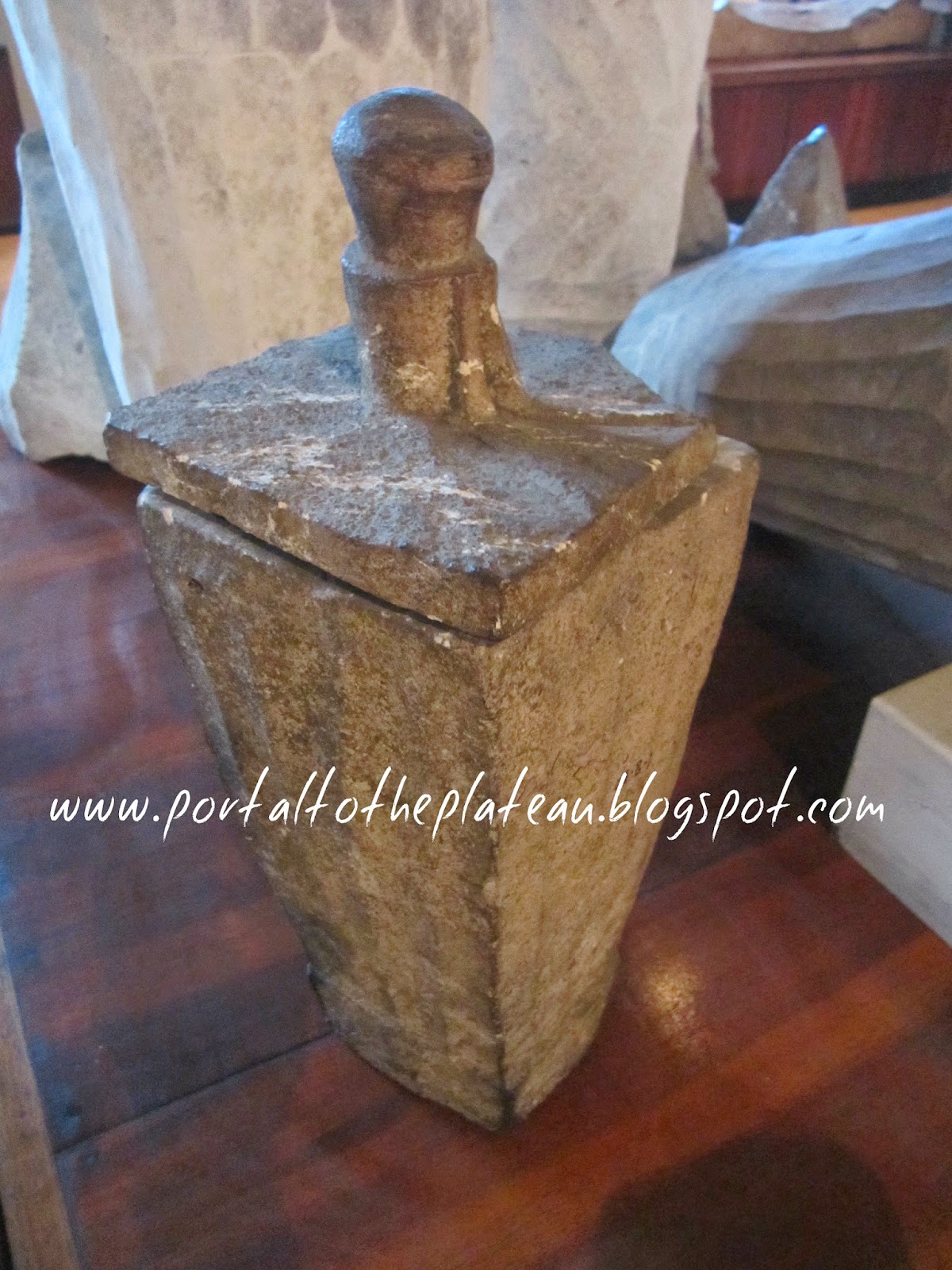
Like what Marcelino Maceda did in his article in the journal Anthropos, I’m going to list here some burial jar covers and their respective descriptions. My original plan was to compare the list in Maceda’s article and the displayed items in the University of San Carlos Museum. Maceda selected thirty-five jar covers to include in the paper, and the university museum only has twenty-one now in its collection. I wanted to know which of the twenty-one were included in the thirty-five. The task, however, was headache-inducing. I decided to do the comparison some other time and focus instead on the museum collection.
Unlike what Maceda did, I can’t give you exact measurements of the jar covers. I’m basing my descriptions on the photos that I took more than three years ago. I assigned numbers on the artifacts based on how they were displayed when I took the photos. Two of the covers still serve their purpose because the jars they were made for have survived. I numbered the two last. Jar Cover No. 21 is shown in the second and third photo below, but I can’t put a number on it because the number icons in PhotoScape, the photo-editing software I used, are up to 20 only.
1—This is round and flat.
2—This is shaped like a gable and rectangular at the base.
3—This is shaped like an inverted bowl and decorated with honeycomb figures from the base to the top.
4—This is round and flat at the base, on which stands a phallus.
5—This is round and thick at the base, on which stands a short pole. The pole is decorated with honeycomb figures.
6—This is circular, squat, and shaped like a stopper for a bottle.
7—This is round and thick at the base, on which stands a short pole that is phallic at the top.
8—This looks like a bust, but the head is shaped like a diamond. On the chest, two tiny arms are carved. The arms look as though the person is touching his her heart.
9—This is shaped like an inverted bowl at the base and phallic from the middle to the top. Eyes, nose, and ears are carved on the glans penis.
10—This is shaped like an inverted bowl at the base. Two legs are carved on the base, and there’s a tiny protrusion between them, probably representing a penis. The base extends upward into a short pole, which is broken. The figure attached on top of the pole may be from another specimen because its color is not same. The figure is shaped like a neck and a head of a human being, with excavated eyes, ears, and mouth.
11—This is a bust of a man. The base is circular and shaped like an inverted bowl. The arms of the figure are embossed and form a semicircle. Three straight grooves run from the neck of the figure to the edge of the base. The head looks like a real person, with the eyes and mouth excavated and the nose and ears embossed.
12—This is a pyramid but has a circular base.
13—This is shaped like a standing human being, but the legs are merely carved on the base, which looks like an inverted bowl. The figure is as humanlike as a doll, but the left arm is missing.
14—This is flat and circular at the base, which supports a figure of a person’s upper body. The frontal part of the figure appears to have crumbled.
15—This looks like an elongated gable. On one side is an embossed outline of a human body, but the arms and legs stretch outward before curving down. The fingers and toes are large and long.
16—This is circular and nearly flat at the base, which supports a short pole that slightly goes smaller in circumference as it goes higher. A ropelike protrusion goes around the pole in the middle, making the pole look as though it has two layers. Spiral flutings decorate the base, and vertical flutings decorate the pole.
17—This is circular and thick yet flat at the base. Jutting from the base is a short knob that goes wider as it goes higher. Simple straight flutings decorate the sides of the knob and the top surface of the base.
18—This is round and flat at the base, which supports a large figure of a neck and a man’s head. The eyes, the holes of the nose, and the mouth are excavated, and the ears are slightly embossed.
19—This is shaped like a gable and nearly square at the base. The diamond-like cut at the top of the gable is probably a yoni.
20—This is shaped like a gable. On one side, it has a figure of a human being that resembles a lizard. The figure has a tail, and the arms and legs are splayed out. The head has holes representing eyes and a mouth. I don’t have a good photo of the other side of the lid, but according to Maceda’s journal article, the other side has a similar figure but without a tail.
21—This is square, thin, and flat at the base, which supports a short pole with a glans penis at the top. The glans penis has holes that represent a person’s eyes, nostrils, and mouth. Arms that look like limbs of a lizard are carved from just below the glans penis down to the length of the pole and the top surface of the base until they reach the edge.
A Guide to Kulaman Plateau and Its Manobo People, Lost Burial Jars, and Hundred Caves
Showing posts with label University of San Carlos. Show all posts
Monday, April 4, 2016
Jar Covers in USC Museum
Monday, March 28, 2016
Jar Covers that Depict Shamans
It’s common knowledge that the people who lived a long time ago considered the shaman an important part of the community. The shaman could be as powerful as the chieftain and could even be the chieftain himself. So if the shaman died, it was perhaps only fitting for the people to remember or try to immortalize him for his significant role. Apparently, this is what the burial jar people did about 1,500 years ago. In a paper, anthropologist Marcelino Maceda states that some jar covers found in Kulaman Plateau indicate that the bones inside the jars are that of a tribal priest or medicine man.
Maceda presents thirty-five jar covers in the paper, and three of these, though anthropomorphic like most of the others, have uncanny shapes or markings. They are listed below. The first number in each item reflects the number of the artifact as it appears in the paper, and the second number is the field or museum number. (KN stands for Kan-Nitong Cave.) Also included are relevant portions of Maceda’s descriptions of the jar covers.
9. M-C0007 (KN)
[This gable-shaped cover has] two bas-relief anthropomorphic figures. The first figure is a human resembling a flying lizard.
16. KN-16-0188
The . . . anthropomorphic figure assumes a snake-like or lizard-shaped human head. . . . The face is triangular; the ears extend from the top of the head down to the level of the lower part of the jar and are similar to the hood of a cobra. . . . This figure may represent a shaman who could change his face at will or a medicine man whose forte is curing snake bites.
17. M-00018 (KN)
The figure has a pointed head arising from two triangular ears. . . . This anthropomorphic figure is probably that of a shaman who could change from one form to another, i.e., to a lizard or snake.
I like Maceda’s interpretations of the designs of the three jar covers. Shamans fascinate me; several of the short stories I’ve written have shamans in them. I wonder, though, if Maceda is being too imaginative in the case of Jar Cover No. 16. The ears that are “similar to the hood of a cobra” may just be enlarged thyroid glands. Goiter is not uncommon among present-day Dulangan Manobos due to nutritional deficiency in their diet. The case must have been worse among the burial jar people about 1,500 years ago. It’s possible that the jar cover is simply depicting an ordinary tribesman with an ordinary affliction, not a leader with supernatural abilities. We can’t know for sure. For now, we can only speculate. Everyone can be an expert. Further research should be done on the burial jars. The items that have been discovered should be reviewed in light of more recent archaeological findings, and Kulaman Plateau should be explored again for possible burial sites that have not been disturbed yet.
M-C0007 (no. 9 in Maceda’s paper) has a figure of a human being
resembling a lizard, probably indicating that the person
buried in the jar was a shaman or magician.
Maceda presents thirty-five jar covers in the paper, and three of these, though anthropomorphic like most of the others, have uncanny shapes or markings. They are listed below. The first number in each item reflects the number of the artifact as it appears in the paper, and the second number is the field or museum number. (KN stands for Kan-Nitong Cave.) Also included are relevant portions of Maceda’s descriptions of the jar covers.
9. M-C0007 (KN)
[This gable-shaped cover has] two bas-relief anthropomorphic figures. The first figure is a human resembling a flying lizard.
16. KN-16-0188
The . . . anthropomorphic figure assumes a snake-like or lizard-shaped human head. . . . The face is triangular; the ears extend from the top of the head down to the level of the lower part of the jar and are similar to the hood of a cobra. . . . This figure may represent a shaman who could change his face at will or a medicine man whose forte is curing snake bites.
17. M-00018 (KN)
The figure has a pointed head arising from two triangular ears. . . . This anthropomorphic figure is probably that of a shaman who could change from one form to another, i.e., to a lizard or snake.
I like Maceda’s interpretations of the designs of the three jar covers. Shamans fascinate me; several of the short stories I’ve written have shamans in them. I wonder, though, if Maceda is being too imaginative in the case of Jar Cover No. 16. The ears that are “similar to the hood of a cobra” may just be enlarged thyroid glands. Goiter is not uncommon among present-day Dulangan Manobos due to nutritional deficiency in their diet. The case must have been worse among the burial jar people about 1,500 years ago. It’s possible that the jar cover is simply depicting an ordinary tribesman with an ordinary affliction, not a leader with supernatural abilities. We can’t know for sure. For now, we can only speculate. Everyone can be an expert. Further research should be done on the burial jars. The items that have been discovered should be reviewed in light of more recent archaeological findings, and Kulaman Plateau should be explored again for possible burial sites that have not been disturbed yet.
M-C0007 (no. 9 in Maceda’s paper) has a figure of a human being
resembling a lizard, probably indicating that the person
buried in the jar was a shaman or magician.
Monday, March 21, 2016
Jar Covers that Indicate Age
Marcelino Maceda, the first anthropologist to formally study the limestone burial jars of Kulaman Plateau, says in a paper that the lines in some of the jar covers may not be merely decorative. He believes that they might be an indication of the age of the person buried in the jar. Such markings are found in six of the thirty-five jar covers that Maceda discusses in the paper. They are listed below. The first number in each item reflects the number of the artifact as it appears in the paper. The second number is the field or museum number. KN stands for Kan-Nitong Cave, and FE stands for Fenefe Cave. I also added Maceda’s descriptions of the features that possibly indicate age.
8. KN-17-A—small and has six flutings on one side of the gable, possibly for a female child
14. KN-11-A—has a line drawing of a human with a vulva on one side of the gable and has angular cuts at the corner of the gable
15. KN-12-0142—shaped like the head of a man and has twenty-five parallel flutings covering the base
20. KN-45-0330—has fifteen large serrations and twenty-one small ones at the top of the gable
26. KN-49-0134—has ten to eleven angular cuts on the corners of the gable, possibly for two young females
33. KN-34-0221 20—has twenty flutings at the base of the pagoda
KN-12-0142 (no. 15 in Maceda’s paper) has twenty-five parallel flutings at the base, just below the neck (barely visible in the photo). Maceda believes the flutings may represent the age of the man buried in the jar.
8. KN-17-A—small and has six flutings on one side of the gable, possibly for a female child
14. KN-11-A—has a line drawing of a human with a vulva on one side of the gable and has angular cuts at the corner of the gable
15. KN-12-0142—shaped like the head of a man and has twenty-five parallel flutings covering the base
20. KN-45-0330—has fifteen large serrations and twenty-one small ones at the top of the gable
26. KN-49-0134—has ten to eleven angular cuts on the corners of the gable, possibly for two young females
33. KN-34-0221 20—has twenty flutings at the base of the pagoda
KN-12-0142 (no. 15 in Maceda’s paper) has twenty-five parallel flutings at the base, just below the neck (barely visible in the photo). Maceda believes the flutings may represent the age of the man buried in the jar.
Monday, March 14, 2016
Jar Covers that Indicate Sex
Look at the base of the jar cover, specifically
at the dot-like protrusion between the leg-like carvings. The protrusion
indicates that the person buried in the jar was male. On the left-hand corner
of the photo is KN-9 (no. 25 in Maceda’s paper), an amalgamation of human head
and glans penis.
When I was still working in Cebu, I once joked to an officemate that my hometown—Kulaman Plateau—had 1,500-year-old dildos. I was referring, of course, to the phallus-shaped lids of some of the limestone jars. I never repeated that joke on social media, even if I was fond at the time of posting on Facebook almost everything that was happening in my life, simply because I thought it was inappropriate. The jars, after all, were used for burial and therefore sacred. Now, though, I’m making that joke public because I realized, after thoroughly reading a paper by anthropologist Marcelino Maceda, that it wasn’t my mind’s fault if it associated some of the jar covers with human sex organs. I learned from the paper that, indeed, the jar covers might have been made phallic deliberately. For the carvers 1,500 years ago, because they didn’t have a system of writing yet, the best way to indicate the sex of dead people was to draw or carve their sex organs on the jars that they had been buried in.
In the paper “Preliminary Studies of the Figures and Ornamentation of Some Selected Jar Covers from Kulaman Plateau (Southwestern Cotabato), Island of Mindanao, Philippines,” published in Anthropos in 1967, Maceda states that of the thirty-five selected jar covers, more than half indicates whether the remains inside them belong to a male or female individual. Fourteen of the covers appear to point out that they contain men. They are listed below. The first number in each item reflects the number of the artifact as it appears in Maceda’s paper. The second number is the field or museum number. KN stands for Kan-Nitong Cave, and FE stands for Fenefe Cave.
9. M-C0007 (KN)—shaped like a gable, has a bas-relief of a human resembling a flying lizard, assumed to depict a shaman
11. KN-20-0128—shaped like a standing human being with a lingam between the thighs
13. KN-34-0265—realistic bust of a male child
15. KN-12-0142—shaped like a human head, size and look seems to depict an important man
16. KN-16-0188—shaped like a human head with something that resembles the hood of a cobra, assumed to depict a shaman
17. M-00018 (KN)—shaped like a human head but with triangular forehead and ears, assumed to depict a shaman
18. FE-11-8—shaped like a standing human being with a hanging chin that possibly depicts a beard and whiskers, with additional line drawing of a human figure at the back
21. M-C003 (FE)—shaped like a human head, with “realistic” features
22. KN-34-0166—human bust “probably” representing “a young male specimen”
23. KN-49-A—made of clay, shaped like a human being leaning backward, possibly representing a leader or a child (due to its smallness) watching an event
24. M-001 (FE)—shaped like a human head with a haughty expression, probably depicting a male leader
25. KN-9—phallic with features of a human face on one side
27. M-C005—phallic with features of a human face on one side
28. KN-5-0102—phallic with features of a human face on one side
The paper also states that number 7, KN-15-0294, “indicates that the bones contained in the jar were those of a male individual.” I wonder if the specified is a typographical error. The paper states that the cover is gable-shaped and the human figure on one side of the gable has widespread legs. Maceda normally associates these features with female specimens, as in these nine jar covers:
2. KN-17-0164—shaped like a gable, with a human bas-relief that has widespread legs
3. KN-12-0157—shaped like a gable, with spiral fluting
4. KN-8-0015—shaped like a gable, with honeycomb figures
8. KN-17-A—shaped like a gable, with diamond figure incised on one side
14. KN-11-A—shaped like a gable, has abstraction of a human figure with a vulva, has another figure showing the buttocks of a woman with the yoni extending forward
19. KN-17-0166—shaped like a gable, with line drawings of human figures emphasizing breasts and buttocks
20. KN-45-0330—shaped like a gable, has “abstractions which may indicate a female specimen”
26. KN-49-0134—shaped like a pyramid, has lines representing two human figures, one of which has a double yoni and the other has one yoni
34. FE-X-24—shaped like a pyramid, has a line drawing of a woman with mammary glands, womb, and yoni
Not all the figures, of course, is clearly phallic or yonic. Number 12, KN-18-B, is shaped like a standing human being with a lingam between four legs, indicating two men, a couple, or twins. Number 10, KN-50-103, has “a figure at its lower part which is a line drawing of a woman with buttocks emphasized,” and “a stick figure with an excavated female genitalia is found a little lower than where the two feet almost meet.” Maceda believes that number 10 is the cover of a jar containing a specimen of an intersexed individual. If he is right, the lid must be the oldest record in Philippine history about homosexuality.
Maceda believes that the widespread legs of the figure in KN-17-0164 indicate that a woman was buried in the jar. He also believes that gable-shaped jar covers, resembling houses, were used for women.
When I was still working in Cebu, I once joked to an officemate that my hometown—Kulaman Plateau—had 1,500-year-old dildos. I was referring, of course, to the phallus-shaped lids of some of the limestone jars. I never repeated that joke on social media, even if I was fond at the time of posting on Facebook almost everything that was happening in my life, simply because I thought it was inappropriate. The jars, after all, were used for burial and therefore sacred. Now, though, I’m making that joke public because I realized, after thoroughly reading a paper by anthropologist Marcelino Maceda, that it wasn’t my mind’s fault if it associated some of the jar covers with human sex organs. I learned from the paper that, indeed, the jar covers might have been made phallic deliberately. For the carvers 1,500 years ago, because they didn’t have a system of writing yet, the best way to indicate the sex of dead people was to draw or carve their sex organs on the jars that they had been buried in.
In the paper “Preliminary Studies of the Figures and Ornamentation of Some Selected Jar Covers from Kulaman Plateau (Southwestern Cotabato), Island of Mindanao, Philippines,” published in Anthropos in 1967, Maceda states that of the thirty-five selected jar covers, more than half indicates whether the remains inside them belong to a male or female individual. Fourteen of the covers appear to point out that they contain men. They are listed below. The first number in each item reflects the number of the artifact as it appears in Maceda’s paper. The second number is the field or museum number. KN stands for Kan-Nitong Cave, and FE stands for Fenefe Cave.
9. M-C0007 (KN)—shaped like a gable, has a bas-relief of a human resembling a flying lizard, assumed to depict a shaman
11. KN-20-0128—shaped like a standing human being with a lingam between the thighs
13. KN-34-0265—realistic bust of a male child
15. KN-12-0142—shaped like a human head, size and look seems to depict an important man
16. KN-16-0188—shaped like a human head with something that resembles the hood of a cobra, assumed to depict a shaman
17. M-00018 (KN)—shaped like a human head but with triangular forehead and ears, assumed to depict a shaman
18. FE-11-8—shaped like a standing human being with a hanging chin that possibly depicts a beard and whiskers, with additional line drawing of a human figure at the back
21. M-C003 (FE)—shaped like a human head, with “realistic” features
22. KN-34-0166—human bust “probably” representing “a young male specimen”
23. KN-49-A—made of clay, shaped like a human being leaning backward, possibly representing a leader or a child (due to its smallness) watching an event
24. M-001 (FE)—shaped like a human head with a haughty expression, probably depicting a male leader
25. KN-9—phallic with features of a human face on one side
27. M-C005—phallic with features of a human face on one side
28. KN-5-0102—phallic with features of a human face on one side
The paper also states that number 7, KN-15-0294, “indicates that the bones contained in the jar were those of a male individual.” I wonder if the specified is a typographical error. The paper states that the cover is gable-shaped and the human figure on one side of the gable has widespread legs. Maceda normally associates these features with female specimens, as in these nine jar covers:
2. KN-17-0164—shaped like a gable, with a human bas-relief that has widespread legs
3. KN-12-0157—shaped like a gable, with spiral fluting
4. KN-8-0015—shaped like a gable, with honeycomb figures
8. KN-17-A—shaped like a gable, with diamond figure incised on one side
14. KN-11-A—shaped like a gable, has abstraction of a human figure with a vulva, has another figure showing the buttocks of a woman with the yoni extending forward
19. KN-17-0166—shaped like a gable, with line drawings of human figures emphasizing breasts and buttocks
20. KN-45-0330—shaped like a gable, has “abstractions which may indicate a female specimen”
26. KN-49-0134—shaped like a pyramid, has lines representing two human figures, one of which has a double yoni and the other has one yoni
34. FE-X-24—shaped like a pyramid, has a line drawing of a woman with mammary glands, womb, and yoni
Not all the figures, of course, is clearly phallic or yonic. Number 12, KN-18-B, is shaped like a standing human being with a lingam between four legs, indicating two men, a couple, or twins. Number 10, KN-50-103, has “a figure at its lower part which is a line drawing of a woman with buttocks emphasized,” and “a stick figure with an excavated female genitalia is found a little lower than where the two feet almost meet.” Maceda believes that number 10 is the cover of a jar containing a specimen of an intersexed individual. If he is right, the lid must be the oldest record in Philippine history about homosexuality.
Maceda believes that the widespread legs of the figure in KN-17-0164 indicate that a woman was buried in the jar. He also believes that gable-shaped jar covers, resembling houses, were used for women.
Monday, March 7, 2016
Ten Discoveries from Maceda’s Paper
The jars that anthropologist Marcelino Maceda
studied are now on display
at the University of San Carlos Museum, in Cebu City.
I can’t emphasize enough the value of the research papers written by anthropologist Marcelino Maceda. Reading them has made me understand better and appreciate more the limestone burial jars of Kulaman Plateau. One article alone—specifically “Preliminary Studies of the Figures and Ornamentation of Some Selected Jar Covers from Kulaman Plateau (Southwestern Cotabato), Island of Mindanao, Philippines,” published in Anthropos in 1967—has given me so much information. Many of what I learned from the paper are new to me, and some confirm what I have known or conjectured before. The following are ten of the facts that fascinate me most:
1. The jars aren’t just made of limestone. Maceda says some of the jars are made of “young gypsum.” He therefore uses the general term soft stone in describing the jars. I might continue to use limestone though because it indicates right away that the jars are white.
2. Some of the jars are made of clay. Maceda believes the burial jar people might have used clay at first, but because clay was limited in the area, they turned to the huge blocks of stone in dry riverbeds. They were quite resourceful, weren’t they?
3. More than six hundred specimens were discovered. Maceda’s team explored two caves—Fenefe and Kan-Nitong—in the hamlet of Menteng, and they were able to dig up “burial jars (soft stone and clay) and covers, human bones, stone flakes and semi-polished stone tools, ornaments (made of ivory, clay, shell, and iron), animal bones and pottery (pots and shards).”
4. The Dulangan Manobo might not have made the jars. I’ve discussed this in my post the previous Monday, so I won’t repeat here the explanations.
5. The jars were being wet while carved with stone tools. Needless to say, carving the jars 1,500 years ago required a great doze of patience. The carvers only had polished stones as tools, so it was difficult to carve the blocks of stones. Fortunately for them, the stones are softer when wet, so while working the stones, the carvers “subjected [them] to a wetting process.”
6. The phallic designs were done on purpose. I’m not just being dirty-minded. Maceda says the designs of the jar covers are an attempt of the carvers to describe the dead person. Indeed, for nonliterate people, the best way to indicate a person’s sex is to draw or carve the shape of his sex organ. For female bodies, of course, the designs on the jar covers are yonic.
7. Lines may indicate age. Maceda says that the “flutings,” “angular cuts,” or “serrations” on some of the artifacts indicate the age of the specimens inside the jars when they died. Maceda observes this in six out of the thirty-five jar covers discussed in the article. He puts a question mark, however, in each of the statements about age, which means that he’s not really sure if the burial jar people had any system of writing numbers.
8. Some figures depict shape-shifting shamans. In three out of the thirty-five jar covers, Maceda observes in them anthropomorphic figures that may be depicting “culture heroes” who can assume the form of snakes or lizards. He believes that the jars possibly contain the bones of shamans, spirit mediums, and the like.
9. Maceda must be the first person to officially call Kulaman a plateau. The anthropologist says that his “companion informed him that somewhere in ‘Kulaman Valley’ were several caves” where jars had been seen. Maceda puts a number in superscript after Kulaman Valley and then explains in the footnote, “Actually this is a dissected plateau with an elevation of more than 2,000 feet. Hence, in the title and in the paper itself this is simply referred to as Kulaman Plateau.”
10. Some of jar covers look like a pagoda or stepped mountain. This is particularly surprising to me because I’ve never seen one in the museums I’ve been to. Maceda’s article includes a photo of two such jar covers. I wonder where they winded up. Not in the University of San Carlos Museum, for sure. My memory and my file photos tell me that there are no pagoda-like or stepped jar covers there.
at the University of San Carlos Museum, in Cebu City.
I can’t emphasize enough the value of the research papers written by anthropologist Marcelino Maceda. Reading them has made me understand better and appreciate more the limestone burial jars of Kulaman Plateau. One article alone—specifically “Preliminary Studies of the Figures and Ornamentation of Some Selected Jar Covers from Kulaman Plateau (Southwestern Cotabato), Island of Mindanao, Philippines,” published in Anthropos in 1967—has given me so much information. Many of what I learned from the paper are new to me, and some confirm what I have known or conjectured before. The following are ten of the facts that fascinate me most:
1. The jars aren’t just made of limestone. Maceda says some of the jars are made of “young gypsum.” He therefore uses the general term soft stone in describing the jars. I might continue to use limestone though because it indicates right away that the jars are white.
2. Some of the jars are made of clay. Maceda believes the burial jar people might have used clay at first, but because clay was limited in the area, they turned to the huge blocks of stone in dry riverbeds. They were quite resourceful, weren’t they?
3. More than six hundred specimens were discovered. Maceda’s team explored two caves—Fenefe and Kan-Nitong—in the hamlet of Menteng, and they were able to dig up “burial jars (soft stone and clay) and covers, human bones, stone flakes and semi-polished stone tools, ornaments (made of ivory, clay, shell, and iron), animal bones and pottery (pots and shards).”
4. The Dulangan Manobo might not have made the jars. I’ve discussed this in my post the previous Monday, so I won’t repeat here the explanations.
5. The jars were being wet while carved with stone tools. Needless to say, carving the jars 1,500 years ago required a great doze of patience. The carvers only had polished stones as tools, so it was difficult to carve the blocks of stones. Fortunately for them, the stones are softer when wet, so while working the stones, the carvers “subjected [them] to a wetting process.”
6. The phallic designs were done on purpose. I’m not just being dirty-minded. Maceda says the designs of the jar covers are an attempt of the carvers to describe the dead person. Indeed, for nonliterate people, the best way to indicate a person’s sex is to draw or carve the shape of his sex organ. For female bodies, of course, the designs on the jar covers are yonic.
7. Lines may indicate age. Maceda says that the “flutings,” “angular cuts,” or “serrations” on some of the artifacts indicate the age of the specimens inside the jars when they died. Maceda observes this in six out of the thirty-five jar covers discussed in the article. He puts a question mark, however, in each of the statements about age, which means that he’s not really sure if the burial jar people had any system of writing numbers.
8. Some figures depict shape-shifting shamans. In three out of the thirty-five jar covers, Maceda observes in them anthropomorphic figures that may be depicting “culture heroes” who can assume the form of snakes or lizards. He believes that the jars possibly contain the bones of shamans, spirit mediums, and the like.
9. Maceda must be the first person to officially call Kulaman a plateau. The anthropologist says that his “companion informed him that somewhere in ‘Kulaman Valley’ were several caves” where jars had been seen. Maceda puts a number in superscript after Kulaman Valley and then explains in the footnote, “Actually this is a dissected plateau with an elevation of more than 2,000 feet. Hence, in the title and in the paper itself this is simply referred to as Kulaman Plateau.”
10. Some of jar covers look like a pagoda or stepped mountain. This is particularly surprising to me because I’ve never seen one in the museums I’ve been to. Maceda’s article includes a photo of two such jar covers. I wonder where they winded up. Not in the University of San Carlos Museum, for sure. My memory and my file photos tell me that there are no pagoda-like or stepped jar covers there.
Monday, July 21, 2014
Anthropomorphic Lids
The photos in this post were all taken at the University of San Carlos Museum in Cebu City. Most of the figures are crudely carved, and some look more like monkeys than human beings. However, probably out of respect by the authors, none of the academic papers I've read so far states that the lids are simian. Curiously, though, a paper or two describe the lids as "phallic," though I can't identify right now which papers do.
Look closely at the photos at the bottom of this post. The one on the right-hand side is a close-up of the lid of the jar at the left. When I first saw the jar in the museum, I thought to myself that the lid was indeed phallic. But when I looked at it closely, I noticed that tiny holes were bored into it, and the holes resembled a human being's eyes, nostrils, and mouth. I wondered if the lid was just unintentionally phallic.
I also remember now that I read in one academic paper that some of the Kulaman jars have designs that indicate the sex of the deceased interred inside. I'll get back to you on this in future posts. It's interesting to think that the ancient people of Kulaman Plateau had manifestations of their sexuality in their art. They were, after all, human beings like us—living, loving, longing.
Labels:
burial jars,
museums,
University of San Carlos
Tuesday, November 13, 2012
Kulaman Jars in Cebu
I wasn’t able to update this blog for more than a week, again, because I’ve been to a writing workshop, again. This time, it was in Cebu. Yes, Cebu, where some of the Kulaman burial jars were taken.
Of course, I didn’t let the opportunity to see the jars pass. On November 5, Monday, I dropped by the University of San Carlos Museum, and for the first time, I was able to see the actual jars, not just their online photos. I even ran my fingers along their ridges. It was a surreal experience. I found myself on the verge of tears.
The jars were displayed atop a knee-high wooden platform about two meters wide and four meters long. The platform was placed right in the center of the museum, which was about the size of three classrooms joined at the sides. Thus I can say that the burial jars from Kulaman are the most prominently featured, and maybe the most valuable, artifacts in the museum.
After my extensive online research, I thought I had become a connoisseur of sorts of the jars. I was taken aback when I could not properly classify the artifacts in front of me. I tried my best, though, and I came up with an inventory of burial jars in USC’s possession.
I counted thirty-seven items in all, but only two of them were complete. One was medium-sized, circular, and nearly immaculate. Its body had bold diagonal ridges, and its cover was in the shape of a tent. Carved on the cover were two figures of lizardlike men. The figures were placed back-to-back, on the two wider sides of the cover.
Another complete item was a small quadrilateral jar that appeared grimy. It had dark yellow streaks around it. Its simple flat cover had a protruding knob. At first I thought the design was phallic, but on closer inspection, I found out that tiny holes had been bored on the knob to make it appear like a human face.
Including the two complete ones, there were eighteen jars altogether. The rest of the thirty-seven items were mostly anthropomorphic lids and some fragments I could not identify. Of the eighteen jars, only three were quadrilateral; the others were circular. Two were more than one meter high. Most had simple vertical or diagonal ridges around their bodies, but one of the tallest had a carved figure of a man.
The jars, or at least the ones that didn’t have covers, were empty, so there were no Late Neolithic human bones to see. The collection, though, also had some pieces that were discovered with the jars. They were tacked on a board near the wall, and they included stones, shells, and boars’ teeth.
Of course, I didn’t let the opportunity to see the jars pass. On November 5, Monday, I dropped by the University of San Carlos Museum, and for the first time, I was able to see the actual jars, not just their online photos. I even ran my fingers along their ridges. It was a surreal experience. I found myself on the verge of tears.
The jars were displayed atop a knee-high wooden platform about two meters wide and four meters long. The platform was placed right in the center of the museum, which was about the size of three classrooms joined at the sides. Thus I can say that the burial jars from Kulaman are the most prominently featured, and maybe the most valuable, artifacts in the museum.
After my extensive online research, I thought I had become a connoisseur of sorts of the jars. I was taken aback when I could not properly classify the artifacts in front of me. I tried my best, though, and I came up with an inventory of burial jars in USC’s possession.
I counted thirty-seven items in all, but only two of them were complete. One was medium-sized, circular, and nearly immaculate. Its body had bold diagonal ridges, and its cover was in the shape of a tent. Carved on the cover were two figures of lizardlike men. The figures were placed back-to-back, on the two wider sides of the cover.
Another complete item was a small quadrilateral jar that appeared grimy. It had dark yellow streaks around it. Its simple flat cover had a protruding knob. At first I thought the design was phallic, but on closer inspection, I found out that tiny holes had been bored on the knob to make it appear like a human face.
Including the two complete ones, there were eighteen jars altogether. The rest of the thirty-seven items were mostly anthropomorphic lids and some fragments I could not identify. Of the eighteen jars, only three were quadrilateral; the others were circular. Two were more than one meter high. Most had simple vertical or diagonal ridges around their bodies, but one of the tallest had a carved figure of a man.
The jars, or at least the ones that didn’t have covers, were empty, so there were no Late Neolithic human bones to see. The collection, though, also had some pieces that were discovered with the jars. They were tacked on a board near the wall, and they included stones, shells, and boars’ teeth.
Labels:
burial jars,
Cebu,
museums,
University of San Carlos
Subscribe to:
Posts (Atom)