A Guide to Kulaman Plateau and Its Manobo People, Lost Burial Jars, and Hundred Caves
Showing posts with label museums. Show all posts
Wednesday, December 30, 2015
A List of Limestone Jars in Sultan Kudarat Museum
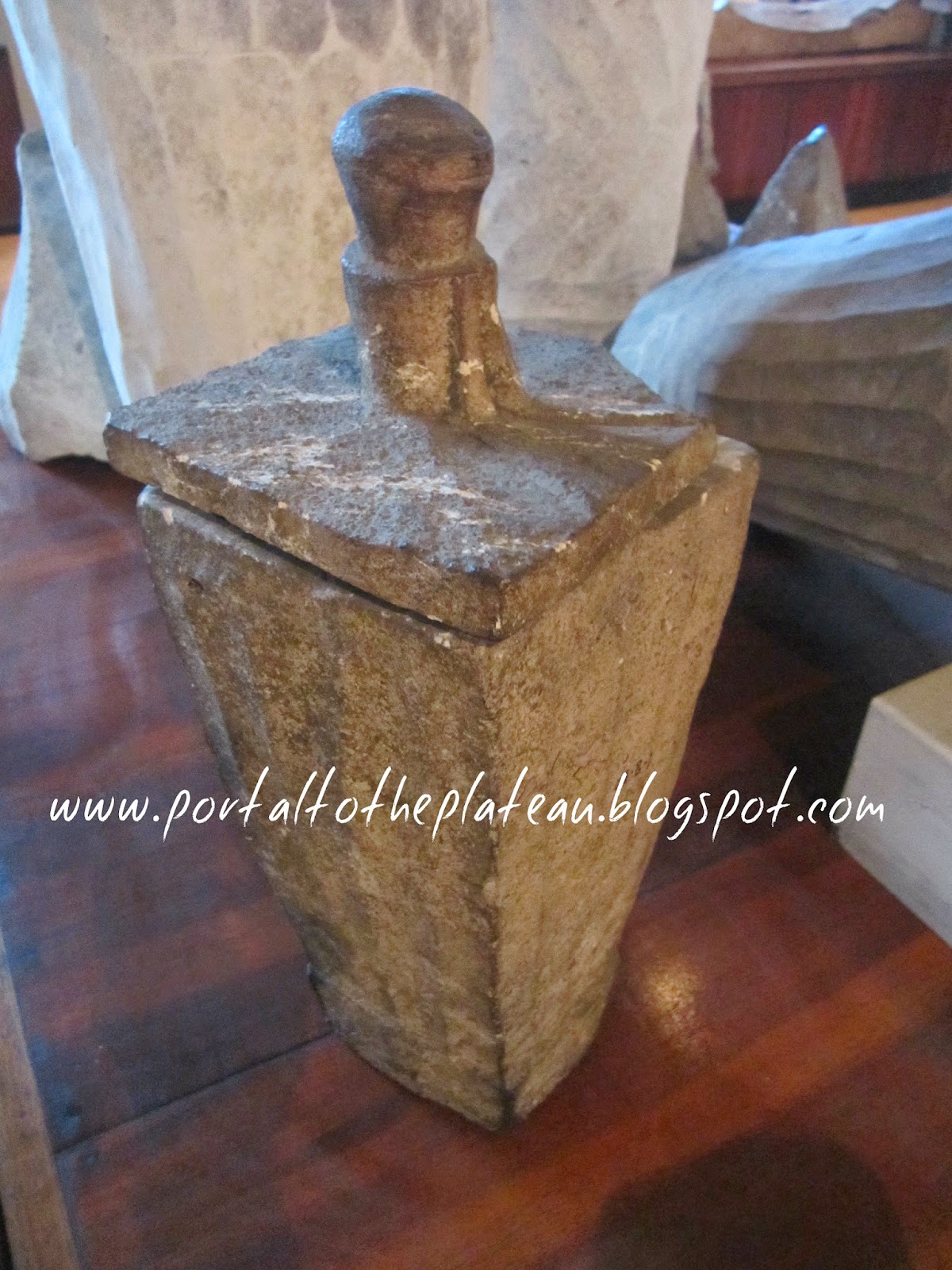
The Provincial Tourism Office and Museum of Sultan Kudarat contains fourteen specimens of limestone burial jars. One is a jar with a lid, two are jars that are almost intact, six are fragments of jars, and five are lids that have been separated from the jars that they used to cover. Most of these specimens are placed in front of the tall display case that contains items from the municipality of Lebak. The smallest of the almost-intact jars is inside the display case. The large jar that has a lid has been moved from one spot to another. It cannot be ascertained yet which municipality it came from. It’s the first limestone jar that came into the museum’s possession, and it is a subject of my post more than a year ago. Below are my more-detailed notes on all fourteen specimens.
1—This is a piece of a broken small quadrangular jar.
2—This is a lid that has a circular base and missing top.
3—This is a big cylindrical jar with vertical flutings.
4—This is the base of a quadrangular jar with vertical flutings.
5—This is a lid that looks like an inverted bowl at the base and has a simple tubelike handle. The surface is covered with vertical flutings.
6—This is a piece of a broken small quadrangular jar with flutings on the sides.
7—This is a jar cover that is squarelike at the base and topped by a figure of a bald human head. The right side of the head is missing, including the right eyebrow and the right eye. The left eyebrow, the left eye, and the mouth are excavated. The nose is embossed. The face looks serene; the person buried in the jar might have been a sage or a venerated chieftain. Tiny arms are embossed from the neck of the figure to the edge of the base.
8—This is a piece of a broken small quadrangular jar.
9—This is smaller than specimen no. 8 and probably a part of it.
10—This is the base of a broken quadrangular jar.
11—This is a lid that is square and flat at the base and topped by a round handle. The surface is pockmarked, heavily on the handle and lightly on the base. Tiny and close lines run from the bottom of the handle to the edge of the base.
12—This is a spherical lid topped by a tubelike handle with a missing upper part.
13—This is a tiny quadrangular jar broken on one side. The surface is adorned with horizontal lines that have crisscrossing diagonal lines in between. The lines are thin and straight, which indicates that a sharp and tiny metal was used in making them, which indicates that the jar is newer than the ones that were carved using stone flakes.
14—This is a big quadrangular burial jar with a pyramid-shaped lid. Diamond-like designs cover the entire surface. One side of the lid is broken at the base, forming a horizontal and oblong hole.
Specimen no. 13 in Sultan Kudarat Museum
Jars from Lebak in Sultan Kudarat Museum
Limestone burial jars and other interesting items from
Lebak town
My mother told me, “I didn’t know you wrote something about burial jars for the provincial museum.” I frowned and answered, “No, I didn’t.” She explained that she had been to the Provincial Tourism Office and Museum to transact some business and she had seen a label for burial jars there that mentioned my name. “You wrote that the jars are one thousand five hundred years old,” she added.
I figured out that the staff of the tourism office must have quoted something I wrote online. “No,” I told my mom. “It wasn’t me who said the jars are that old. I was simply quoting an anthropologist who did a test on a bone that was found inside a jar.” I was embarrassed that something scientific was attributed to me, a blogger who has too much time in his hand. I decided to visit the museum to ask the staff there to change whatever needed changing. I also wanted to see the burial jars that my mom had described. She had told me that the museum had several pieces of burial jars from the municipality of Lebak. I had not seen them before. When I went to the museum more than a year earlier, the place only had one large burial jar.
I didn’t see the label that my mom had told me about. It was supposed to be attached to the large burial jar, which had been placed in front of a display case containing Dulangan Manobo items from the municipality of Senator Ninoy Aquino. When I went to the museum, the burial jar had been moved to another spot, and the label must have been lost in the process. But I did see the new burial jars, placed in front of the display case for the municipality of Lebak, and I recognized right away that the label for the jars was a verbatim quotation from an essay of mine that had appeared in Philippine Daily Inquirer. I wasn’t cited in the label, but I didn’t complain. I simply wanted to make sure that no one was quoting me as if I had a PhD and carbon-dating apparatus.
The label says the jars are from Lugping and donated by a certain Ugkaw A. Mamaku. I don’t know where exactly Lugping is. It must just be a sitio, for it’s not one of the barangays of Lebak that are listed in the 2010 Socio-Economic Profile of Sultan Kudarat Province. Mamaku must also be an ordinary Manobo or one of the lesser-known chieftains, for I can’t find his name among the datus who promulgated the Kitab, or Dulangan Manobo Customary Law, in 2011.
The new set of burial artifacts comprises one semicomplete big jar, five jar covers, and six jar pieces. The smallest of the broken pieces probably belong to one of the bigger ones. The specimens are all placed in front of the tall display case allotted for Lebak. There’s an additional semicomplete tiny jar inside the display case. I’ll give you more details about the specimens in my next post. I’ll have an inventory of them so that they can be traced or recovered in case they become missing.
My mother told me, “I didn’t know you wrote something about burial jars for the provincial museum.” I frowned and answered, “No, I didn’t.” She explained that she had been to the Provincial Tourism Office and Museum to transact some business and she had seen a label for burial jars there that mentioned my name. “You wrote that the jars are one thousand five hundred years old,” she added.
I figured out that the staff of the tourism office must have quoted something I wrote online. “No,” I told my mom. “It wasn’t me who said the jars are that old. I was simply quoting an anthropologist who did a test on a bone that was found inside a jar.” I was embarrassed that something scientific was attributed to me, a blogger who has too much time in his hand. I decided to visit the museum to ask the staff there to change whatever needed changing. I also wanted to see the burial jars that my mom had described. She had told me that the museum had several pieces of burial jars from the municipality of Lebak. I had not seen them before. When I went to the museum more than a year earlier, the place only had one large burial jar.
I didn’t see the label that my mom had told me about. It was supposed to be attached to the large burial jar, which had been placed in front of a display case containing Dulangan Manobo items from the municipality of Senator Ninoy Aquino. When I went to the museum, the burial jar had been moved to another spot, and the label must have been lost in the process. But I did see the new burial jars, placed in front of the display case for the municipality of Lebak, and I recognized right away that the label for the jars was a verbatim quotation from an essay of mine that had appeared in Philippine Daily Inquirer. I wasn’t cited in the label, but I didn’t complain. I simply wanted to make sure that no one was quoting me as if I had a PhD and carbon-dating apparatus.
The label says the jars are from Lugping and donated by a certain Ugkaw A. Mamaku. I don’t know where exactly Lugping is. It must just be a sitio, for it’s not one of the barangays of Lebak that are listed in the 2010 Socio-Economic Profile of Sultan Kudarat Province. Mamaku must also be an ordinary Manobo or one of the lesser-known chieftains, for I can’t find his name among the datus who promulgated the Kitab, or Dulangan Manobo Customary Law, in 2011.
The new set of burial artifacts comprises one semicomplete big jar, five jar covers, and six jar pieces. The smallest of the broken pieces probably belong to one of the bigger ones. The specimens are all placed in front of the tall display case allotted for Lebak. There’s an additional semicomplete tiny jar inside the display case. I’ll give you more details about the specimens in my next post. I’ll have an inventory of them so that they can be traced or recovered in case they become missing.
One of the more beautiful specimens in Sultan
Kudarat Museum
A more realistic sample compared to other
anthropomorphic lids
(Update: These jars may be fake. Check out this
post for the explanation.)
Manobo Items in Sultan Kudarat Museum
You don’t have to come up here in Kulaman Plateau to see the traditional things used by the Dulangan Manobo people. The provincial museum, located in the plains of Isulan town, has such items. The display includes clothes, baskets, and musical instruments. Just a little caveat: If you’re used to going to museums, don’t be surprised with what you will see in our provincial museum, which also functions as the Provincial Tourism Office. The place doesn’t have the subdued look and feel of a standard museum. It is flashy and colorful instead. It seems to me that whoever designed the exhibits has seen a lot of beauty pageants and not a single museum.
The museum has a tall display case for each of the eleven municipalities of Sultan Kudarat Province, and each case has a mannequin or two wearing ethnic clothes. The cut of the clothes is modified, and the cloth is combined with modern materials, and I don’t know why. It’s possibly to make the clothes look “fashionable.” The tribal handicrafts, musical instruments, hunting equipment, and even archaeological artifacts are scattered around the feet of the mannequins like novelty items in a department store. They’re used as mere accessories instead of being highlighted individually. The place is for the eyes and not for the mind.
I can go on endlessly about how bad the provincial museum is, but I’ll focus instead on the good side of things. The place at least has a good collection now. When I visited it last year, it was almost empty. And of course, the province at least has a museum now. It didn’t have any even if it had existed since 1972. Despite my issues with how the place is set up, I still highly encourage you to visit the Sultan Kudarat Provincial Tourism Office and Museum. It’s a two-story small building at the back of the capitol. (Don’t enter the fenced-up capitol grounds. Take the road outside.) If you’re in my province and you want to see traditional Dulangan Manobo objects—and Kulaman Plateau burial jars—the museum is the most accessible site. You only have to ride a tricycle plus a jeepney, depending on where you are from. You don’t have to travel for hours.
The labels are so small, but thankfully, I don’t have to read them because I know the names of common Dulangan Manobo items. This is the bottom of the display case for the municipality of Senator Ninoy Aquino.
The museum has a tall display case for each of the eleven municipalities of Sultan Kudarat Province, and each case has a mannequin or two wearing ethnic clothes. The cut of the clothes is modified, and the cloth is combined with modern materials, and I don’t know why. It’s possibly to make the clothes look “fashionable.” The tribal handicrafts, musical instruments, hunting equipment, and even archaeological artifacts are scattered around the feet of the mannequins like novelty items in a department store. They’re used as mere accessories instead of being highlighted individually. The place is for the eyes and not for the mind.
I can go on endlessly about how bad the provincial museum is, but I’ll focus instead on the good side of things. The place at least has a good collection now. When I visited it last year, it was almost empty. And of course, the province at least has a museum now. It didn’t have any even if it had existed since 1972. Despite my issues with how the place is set up, I still highly encourage you to visit the Sultan Kudarat Provincial Tourism Office and Museum. It’s a two-story small building at the back of the capitol. (Don’t enter the fenced-up capitol grounds. Take the road outside.) If you’re in my province and you want to see traditional Dulangan Manobo objects—and Kulaman Plateau burial jars—the museum is the most accessible site. You only have to ride a tricycle plus a jeepney, depending on where you are from. You don’t have to travel for hours.
The labels are so small, but thankfully, I don’t have to read them because I know the names of common Dulangan Manobo items. This is the bottom of the display case for the municipality of Senator Ninoy Aquino.
By turning ethnic clothes into evening gowns,
the tourism officers of my province have created a showroom, not a museum. The
display case on the left is for the municipality of Lebak. The one on the right
is for Kalamansig.
Monday, July 21, 2014
Anthropomorphic Lids
The photos in this post were all taken at the University of San Carlos Museum in Cebu City. Most of the figures are crudely carved, and some look more like monkeys than human beings. However, probably out of respect by the authors, none of the academic papers I've read so far states that the lids are simian. Curiously, though, a paper or two describe the lids as "phallic," though I can't identify right now which papers do.
Look closely at the photos at the bottom of this post. The one on the right-hand side is a close-up of the lid of the jar at the left. When I first saw the jar in the museum, I thought to myself that the lid was indeed phallic. But when I looked at it closely, I noticed that tiny holes were bored into it, and the holes resembled a human being's eyes, nostrils, and mouth. I wondered if the lid was just unintentionally phallic.
I also remember now that I read in one academic paper that some of the Kulaman jars have designs that indicate the sex of the deceased interred inside. I'll get back to you on this in future posts. It's interesting to think that the ancient people of Kulaman Plateau had manifestations of their sexuality in their art. They were, after all, human beings like us—living, loving, longing.
Labels:
burial jars,
museums,
University of San Carlos
Wednesday, June 25, 2014
Burial Jar in Provincial Museum
I had heard on Facebook how disappointing the museum was, so I was no longer surprised when I found out it barely had anything on display. The two-story modest-sized building, some fifty meters behind the provincial capitol, was newly erected and tastefully designed. Inside, however, the museum only had the following: the Kulaman jar; an anthropomorphic clay figure, similar to the lids of the Maitum burial jars and maybe one of them; a jagged rock with streaks of gold; a made-of-clay kettle; and some brass Maguindanaoan musical instruments.
This is the provincial capitol, and the local museum is behind it.
The back gate might be closed, so take the unpaved road near
the entrance to the capitol but outside the concrete fence.
The collection had no labels whatsoever, and the staff who was in the office was not sure when and how the items came into the possession of the provincial tourism office, but she knew that the burial jar was from the municipality of Senator Ninoy Aquino.
What mildly surprised me about the jar was its size. Among the burial jars I had seen, it was one of the largest and probably had the widest base. Each side of the square base must be at least 15 inches in length. The height of the jar, not counting the lid, was around 36 inches.
The Kulaman burial jar is one of the very few items
in the museum. Below, I took photos of my hand and foot
so that you would have some idea how large the jar is.
The jar looked like a tall rectangular box, and its lid was a plain pyramid. From the tip of the lid to the base, the artifact was covered with simple diagonal lines that formed diamonds. It might have been excavated from Senator Ninoy Aquino because the ones that were found in Lebak mostly had round bodies and human-shaped lids. I've seen Kulaman jars of various sizes and shapes, and the one in the provincial museum is now one of my favorite. It's simple, and its chipped lid notwithstanding, it's sturdy—something that has survived more than a thousand years and could seemingly survive thousands more.
Tuesday, November 13, 2012
Kulaman Jars in Cebu
I wasn’t able to update this blog for more than a week, again, because I’ve been to a writing workshop, again. This time, it was in Cebu. Yes, Cebu, where some of the Kulaman burial jars were taken.
Of course, I didn’t let the opportunity to see the jars pass. On November 5, Monday, I dropped by the University of San Carlos Museum, and for the first time, I was able to see the actual jars, not just their online photos. I even ran my fingers along their ridges. It was a surreal experience. I found myself on the verge of tears.
The jars were displayed atop a knee-high wooden platform about two meters wide and four meters long. The platform was placed right in the center of the museum, which was about the size of three classrooms joined at the sides. Thus I can say that the burial jars from Kulaman are the most prominently featured, and maybe the most valuable, artifacts in the museum.
After my extensive online research, I thought I had become a connoisseur of sorts of the jars. I was taken aback when I could not properly classify the artifacts in front of me. I tried my best, though, and I came up with an inventory of burial jars in USC’s possession.
I counted thirty-seven items in all, but only two of them were complete. One was medium-sized, circular, and nearly immaculate. Its body had bold diagonal ridges, and its cover was in the shape of a tent. Carved on the cover were two figures of lizardlike men. The figures were placed back-to-back, on the two wider sides of the cover.
Another complete item was a small quadrilateral jar that appeared grimy. It had dark yellow streaks around it. Its simple flat cover had a protruding knob. At first I thought the design was phallic, but on closer inspection, I found out that tiny holes had been bored on the knob to make it appear like a human face.
Including the two complete ones, there were eighteen jars altogether. The rest of the thirty-seven items were mostly anthropomorphic lids and some fragments I could not identify. Of the eighteen jars, only three were quadrilateral; the others were circular. Two were more than one meter high. Most had simple vertical or diagonal ridges around their bodies, but one of the tallest had a carved figure of a man.
The jars, or at least the ones that didn’t have covers, were empty, so there were no Late Neolithic human bones to see. The collection, though, also had some pieces that were discovered with the jars. They were tacked on a board near the wall, and they included stones, shells, and boars’ teeth.
Of course, I didn’t let the opportunity to see the jars pass. On November 5, Monday, I dropped by the University of San Carlos Museum, and for the first time, I was able to see the actual jars, not just their online photos. I even ran my fingers along their ridges. It was a surreal experience. I found myself on the verge of tears.
The jars were displayed atop a knee-high wooden platform about two meters wide and four meters long. The platform was placed right in the center of the museum, which was about the size of three classrooms joined at the sides. Thus I can say that the burial jars from Kulaman are the most prominently featured, and maybe the most valuable, artifacts in the museum.
After my extensive online research, I thought I had become a connoisseur of sorts of the jars. I was taken aback when I could not properly classify the artifacts in front of me. I tried my best, though, and I came up with an inventory of burial jars in USC’s possession.
I counted thirty-seven items in all, but only two of them were complete. One was medium-sized, circular, and nearly immaculate. Its body had bold diagonal ridges, and its cover was in the shape of a tent. Carved on the cover were two figures of lizardlike men. The figures were placed back-to-back, on the two wider sides of the cover.
Another complete item was a small quadrilateral jar that appeared grimy. It had dark yellow streaks around it. Its simple flat cover had a protruding knob. At first I thought the design was phallic, but on closer inspection, I found out that tiny holes had been bored on the knob to make it appear like a human face.
Including the two complete ones, there were eighteen jars altogether. The rest of the thirty-seven items were mostly anthropomorphic lids and some fragments I could not identify. Of the eighteen jars, only three were quadrilateral; the others were circular. Two were more than one meter high. Most had simple vertical or diagonal ridges around their bodies, but one of the tallest had a carved figure of a man.
The jars, or at least the ones that didn’t have covers, were empty, so there were no Late Neolithic human bones to see. The collection, though, also had some pieces that were discovered with the jars. They were tacked on a board near the wall, and they included stones, shells, and boars’ teeth.
Labels:
burial jars,
Cebu,
museums,
University of San Carlos
Subscribe to:
Posts (Atom)